
Saturday 20/December/2025 – 08:36 AM
South Sinai Governorate is full of many mines and quarries, and the Sarabit Al-Khadim area in the city of Abu Zneima is considered one of the best places for turquoise, which the ancient Egyptians used in decorations and religious rituals.
Ahmed Adel Aqrab, a tour guide in South Sinai, told Cairo 24 that the Serabit el-Khadim area is distinguished by being the ancient Egyptian turquoise mine, the semi-precious stone that the ancient Egyptian used in adornment and religious rituals from the pre-dynastic era and continued until the end of ancient Egyptian history.
Aqrab confirmed that in Serabit Al-Khadim, Wadi Al-Maghara, Wadi Al-Sahou, and Wadi Al-Nasab, there is turquoise, and it is not found anywhere else in Egypt, and from it Sinai derived its fame as “the land of turquoise,” and in ancient Egyptian, “khtiu-mafakat,” meaning the terraces of turquoise and the atmosphere of the turquoise mountain.
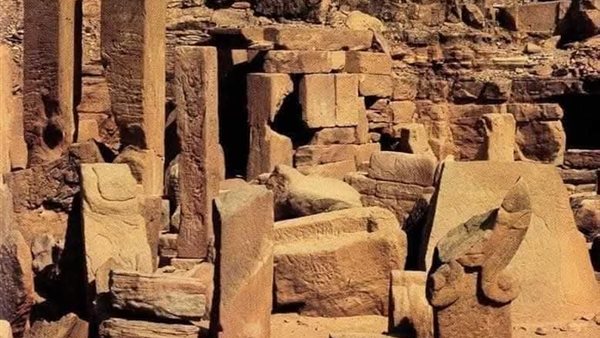
He explained that in the middle of the turquoise caves in Serabit el-Khadim was built the temple of the turquoise lady Hathor, the goddess of love, music and beauty, the goddess of breastfeeding and the sanctuary of Horus, the patroness of workers. It is the oldest ancient Egyptian temple in Sinai, built by Amenemhat I, the founder of the Twelfth Dynasty, and after him the Egyptian kings undertook the construction and additions to the temple until Ramesses VI.
He revealed that the temple was built from Nubian sandstone and its area is 80 meters long from the west, with the entrance to the temple to the east, and 35 meters wide above the top of Mount Serabit, 750 meters high. It is a unique temple in Egyptian civilization in its location, and its axis was built in the shape of the letter L. It witnessed cooperation and coexistence between the Egyptians and the Asian ratnu. They worked together to extract turquoise, and from the Egyptians the ratnu learned to write, so they invented the alphabet, in fact the origin of all… ABCs of the world.
Aqrab pointed out that we find the Sinaiticus alphabet in the Tulayha Cave in Serabit Al-Khadim, in Umm Kubaida in Wadi Al-Nasab, and in Wadi Al-Magharah.
He pointed out that Sarabit Al-Khadim belongs to the village of Ramla in the city of Abu Zenima, South Sinai Governorate, 140 km from the tunnel of the martyr Ahmed Hamdi, and the city of Abu Zenima is located beyond it, and in the same direction, 5 km away, the Sarabit Al-Khadim road branches off and heads east for a distance of 45 km on the car’s odometer. The road is paved, until Sarabit Al-Khadim, where you can ascend the temple from Wadi Baalah, and from there you pass on a journey up the mountain at Rawd al-Air, the most important site. Rock inscriptions in South Sinai, inscriptions from the Middle Kingdom and some from the New Kingdom, commemorative texts for mining expeditions, scenes of giraffes, ostrich, and gazelle, and multiple views of different types of boats. You continue your ascent to the summit, where you will find a path that leads you to Tulayha Cave after visiting it. Return on the same path and continue your way toward the temple. The path is marked, the path is clear, and there are guiding signs. Be careful not to leave anything that pollutes the area or take anything.