

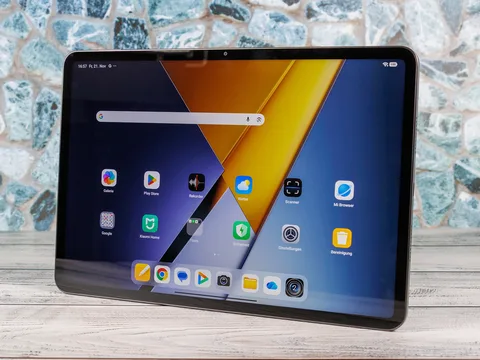
The Poco Pad
The Xiaomi Poco Pad Build quality is impressive with tight gaps and a stable body, although the slightly protruding camera causes the tablet to shake on smooth surfaces. Despite its visual appeal, Xiaomi also decided not to seek IP certification, making it practically unprotected.
The 11.2-inch “LC” screen delivers sharp, high-contrast images, supports HDR technology, and dynamically adjusts the refresh rate up to 144 Hz. It does not flicker, but is prone to glare when viewed from an angle. The Snapdragon 7+ Gen 3 processor ensures smooth system performance and good graphics performance that impresses in daily use. Although it is well equipped with Wi-Fi 6E, NFC, and an infrared blaster, convenience features such as a fingerprint sensor, vibration motor, or headphone jack are missing.
Software maintenance is a positive feature: the “HyperOS 3.0” interface is already based on the “Android 16” system and is scheduled to receive updates for years to come. However, Xiaomi stays true to its habit and pre-installs unwanted ads and apps, which can be removed with little effort.
The speakers provide clear but not deep sound, and the cameras provide solid, if unimpressive, results in daylight. The battery deserves special criticism, as its operating time is much shorter in the test compared to its sister model, the Xiaomi Pad 7.
Since the Poco Pad X1 is not officially available in Germany, there is a shortage of service offers and spare parts, which limits its sustainability. Overall, Xiaomi offers a technically solid, well-built tablet with an attractive screen and fast performance, but it loses some of its luster due to the lack of convenience features and low battery life.