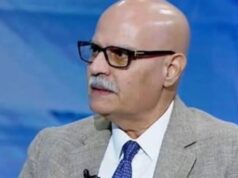

Minister of Higher Education:
• Develop academic programs to match labor market needs and enhance practical training
• Forming a higher committee to review study programs and improve graduate employment in implementation of the directives of the political leadership
• Support applied and technological education to link universities with industry
• Cooperating with the Ministry of Labor to prepare several professional degrees for qualification in the field of occupational health and safety
-Minister of Labor:
• Cooperation with higher education is an essential pillar for developing the training system and linking education to the labor market
• Launching a national initiative to prepare occupational safety and health cadres in partnership with higher education
• Labor representation offices are a tool for marketing Egyptian cadres abroad
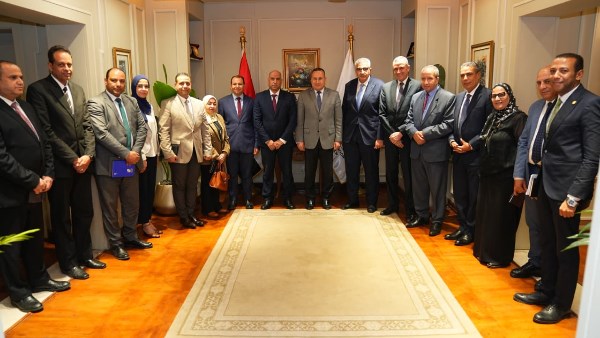
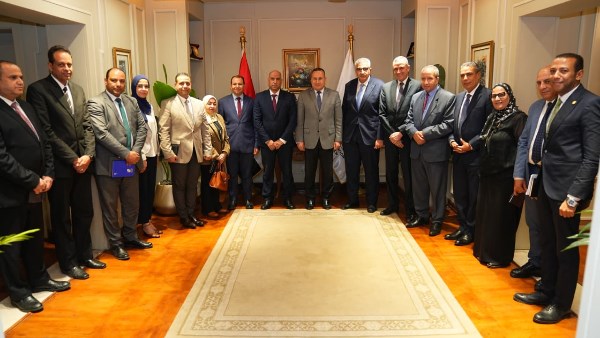
Dr. Abdulaziz Qanswa, Minister of Higher Education and Scientific Research, received Hassan Raddad, Minister of Labor, at the headquarters of the Ministry of Higher Education and Scientific Research in the new capital. To discuss ways to enhance joint cooperation and coordination between the two ministries, in a way that supports integration between higher education outcomes and labor market needs, and contributes to preparing qualified cadres capable of competing locally and internationally, in the presence of a number of leaders of the two ministries.
The Minister of Higher Education stressed the Ministry of Higher Education’s keenness to develop academic and training programs in line with the changing requirements of the labor market, pointing out the importance of expanding practical training, linking students to real work environments, and integrating the concepts of occupational safety and health within the school curricula as it is one of the vital specializations that contribute to raising the efficiency of graduates and enhancing their professional readiness, as well as cooperating with the Ministry of Labor in preparing professional degrees for qualification in the field of occupational health and safety.
The Minister of Higher Education indicated the formation of a higher committee that includes an elite group of experts, in implementation of the directives of the political leadership, which is responsible for reviewing and developing study programs, analyzing graduate employment indicators, and developing modern specializations, in addition to strengthening partnerships with business sectors, in a way that contributes to improving the quality of educational outcomes. He expressed his welcome to cooperation with the Ministry of Labor, especially in implementing specific initiatives to qualify young people according to the needs of the labor market, and benefiting from the Ministry’s studies related to labor market indicators locally, regionally, and internationally.
Qanswa stressed the importance of expanding applied and technological education tracks, and enhancing integration between universities, institutes, and training institutions, allowing students to acquire advanced practical skills that are in line with the requirements of the production and service sectors. He pointed out the importance of supporting continuous follow-up mechanisms to measure the impact of educational programs on graduates’ employment opportunities, and working to develop them dynamically. This ensures effective alignment between educational outcomes and labor market needs locally and internationally.
For his part, Hassan Raddad, Minister of Labor, stressed that cooperation with the Ministry of Higher Education represents a fundamental pillar of the Ministry of Labor’s strategy, especially with regard to spreading the culture of occupational safety and health, and qualifying human resources in accordance with modern standards, explaining that the Ministry is working to bridge the gap between educational outcomes and labor market requirements, through developing the vocational training system and strengthening partnership with the private sector.
The Minister of Labor pointed out the importance of launching a national initiative to prepare cadres specialized in occupational safety and health, in partnership with the Ministry of Higher Education and Scientific Research, stressing that this comes within the framework of enhancing integration between the two ministries and linking education outcomes to the needs of the labor market. He explained that the initiative aims to bridge the skills gap by developing the vocational training system and expanding the partnership with the private sector, which contributes to qualifying cadres capable of keeping pace with the changing requirements of the labor market.
Raddad stressed that the ministry’s efforts include organizing specialized employment forums, preparing to launch the national employment strategy and work platform, in addition to updating the occupational classification guide, in a way that enhances the ability to understand labor market variables and deal with them efficiently. He also stressed the importance of strengthening the link between business owners and job seekers, and benefiting from labor representation offices abroad to support and promote Egyptian cadres, in a way that supports cooperation with the Ministry of Higher Education in preparing qualified and competitive graduates.
The meeting discussed the features of the national initiative to prepare cadres specialized in occupational safety and health, in partnership between the Ministries of Labor and Higher Education. With the aim of building qualified human capabilities to manage the safety system in accordance with international standards, the initiative aims to qualify specialists and technicians through advanced educational and training programs that include a professional diploma and master’s degree, in addition to training programs and certificates for students in the fields of occupational health and safety on the use of personal protective equipment, within the framework of a model that combines academic accreditation and practical application.
The meeting also reviewed the supporting institutional capabilities, most notably the National Center for Studies in Occupational Safety and Health and Securing the Work Environment, with its expertise and advanced training infrastructure in a number of governorates, with an emphasis on activating partnerships with public universities. To ensure geographical spread and integration between the academic and applied sides, it was agreed to form a joint committee to study implementation mechanisms, in preparation for signing a cooperation protocol between the two ministries.
The meeting also discussed activating the “Vocational 2030” project launched by the Ministry of Labor to develop the vocational training system in cooperation with the private sector. With the aim of meeting the needs of the local and international labor market, and providing real job opportunities through accredited training centers.
The meeting dealt with supporting initiatives to qualify workers to work abroad in accordance with international standards, and cooperation between the two sides through the Ministry of Labor providing a comprehensive and integrated electronic platform that is a unified channel for displaying job opportunities locally and internationally, and linking it directly to the data of university graduates made available by the Ministry of Higher Education, which provides an updated database of qualified cadres that contributes to facilitating the matching of skills with the needs of the labor market inside and outside Egypt.
During the meeting, it was emphasized to strengthen the role of labor representation offices in marketing Egyptian cadres, especially university graduates, in addition to organizing specialized employment forums, and updating the occupation classification guide, in a way that supports the state’s efforts in human development and employment, while developing mechanisms for nominating and directing graduates according to the required specializations, and providing periodic analytical data on labor market trends in a way that enhances employment efficiency and links education to the labor market.
The meeting also discussed cooperation in qualifying health services assistant cadres through the “Health Services Assistant” program, which is an accredited vocational training program launched by the Ministry of Labor, which aims to prepare cadres to work in hospitals and medical centers under the supervision of the medical team, to carry out supportive tasks, including measuring vital signs, sterilization, and patient care, in coordination between the Ministries of Labor and Health. To ensure the quality of training and link it to the needs of the health labor market, while examining mechanisms for activating cooperation with university hospitals by forming a joint committee from both sides.
The meeting also discussed including representatives of the Ministry of Higher Education in the Supreme Council for Human Resources Skills Development of the Ministry of Labor, which is responsible for setting general policies for developing human resources skills, in addition to training and qualification policies. This enhances institutional integration and supports the alignment of educational outcomes with the needs of the labor market.
At the conclusion of the meeting, the two sides agreed to continue coordination and integration during the next stage, and to strengthen joint work mechanisms in various files of common interest. This ensures integration between education, training and the labor market, and supports the state’s plans to build and develop human capabilities, in line with the goals of Egypt’s Vision 2030.
The meeting was attended by Dr. Mustafa Refaat, Secretary of the Supreme Council of Universities from the Ministry of Higher Education and Scientific Research, Dr. Ahmed Al-Jayoushi, Secretary of the Supreme Council for Technological Education and Supervisor of the Ministry’s Education Sector, Dr. Al-Sayyid Al-Sharqawi, Chairman of the Basic Sciences Sector Committee, Dr. Hassan Muhammad, Member of the Basic Sciences Sector Committee, Dr. Adel Abdel Ghaffar, Media Advisor and Official Spokesman for the Ministry, and Dr. Hanan Al-Sarsi, Member of the Engineering Sector Committee.
From the Ministry of Labor, Counselor Ihab Abdel-Aty, Legal Advisor, Eng. Yasmine Mamdouh, Head of the Central Administration for Vocational Training, Eng. Mohamed Kamal, Head of the Central Administration for Information and Digital Transformation, Yasser El-Sherbiny, Director of the General Administration for Resolving Collective Labor Disputes, Hend Mohamed, General Director of Labor Market Information, Reda El-Arabi, Supervisor of the Center for Occupational Safety and Health Studies, Hossam Mohamed, Center for Occupational Safety and Health Studies, Dr. Ahmed Farouk, Professor of Public Administration at Beni Suef University, and Abdel-Wahab Khadr, Media Advisor and Speaker. Official.