


Wednesday 15 April 2026 – 07:55 PM
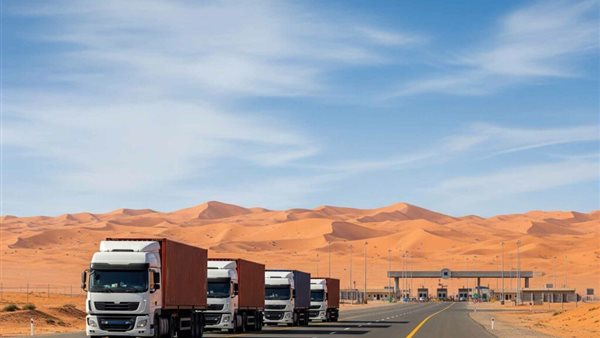
The largest companies producing goods in the Arabian Gulf region, from metals to consumer materials, are adopting a strategy of relying on land transportation as a vital alternative to ensure the continuity of supply chains, as the Strait of Hormuz continues to be closed for the second month in a row.
This transformation prompted major global container shipping companies to provide trucking services, amid local land transport companies recording an unprecedented surge in demand. The current conflict has turned into a catastrophic scenario for trade in non-oil commodities, despite the existence of prior contingency plans to export crude, according to Bloomberg.
In this context, Gaurav Biswas, CEO of Tracker, based in the UAE, revealed that his company, which operates a smart transportation platform, witnessed a 30% jump in land shipments last March.
He explained that the company, which serves giant entities such as Emirates Global Aluminum, DP World, and Unilever, has deployed more than 500 trucks since the first days of the war to secure the flow of goods, especially petrochemicals, metals, and foodstuffs, stressing that the land connection between the interior regions and the ports located on the eastern edge of the Emirates and the Sultanate of Oman has allowed the Strait of Hormuz and the Red Sea to be largely bypassed.
With increasing navigational restrictions, the ports of Jeddah in Saudi Arabia, Salalah and Sohar in Oman have come to the fore as strategic alternatives to traditional Gulf ports such as Jebel Ali.
In response to this reality, the German company Hapag-Lloyd launched land routes through Saudi Arabia and Oman linking to various Gulf countries, and Maersk also provided similar solutions to transport shipments across the region, while Biswas indicated that only the retail and e-commerce sectors had recorded a decline since the start of the conflict with Iran.
In terms of costs, Tracker moved to a daily spot pricing system to confront market fluctuations, as prices jumped by 120% in the UAE and 70% in Saudi Arabia as a result of high fuel prices, supply shortages and operational restrictions, with the lines linking eastern and western Saudi Arabia and cross-border flights between the Emirates and the Kingdom emerging as the most active routes.
According to Biswas, this pressure has led to eastern ports exceeding their capacity, as the UAE port of Khor Fakkan recorded a six-fold increase in the volume of containers, which led to a congestion of ships awaiting unloading and loading operations.