
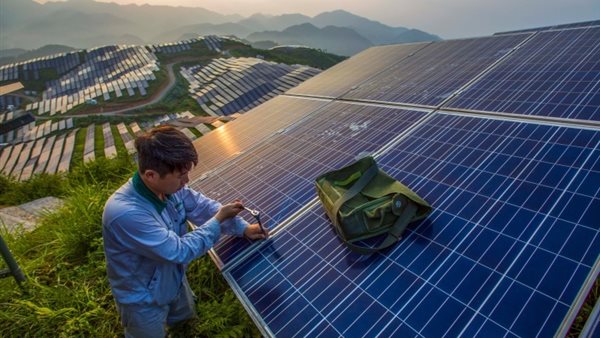
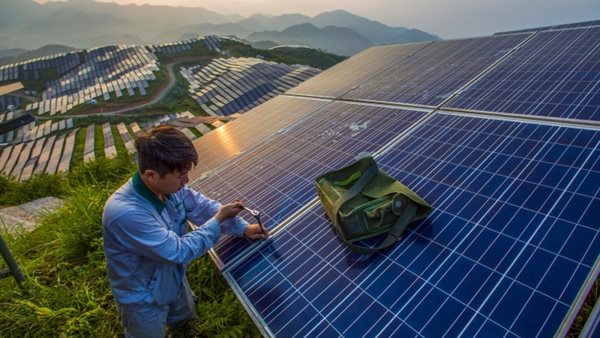
The Market Regulatory Authority urged China Solar energy sector companies call for an end to unfair pricing practices, most notably collusion and fraud, warning that the severe “price wars” witnessed by the sector lead to contraction and unhealthy competition that harms investment and quality alike.
The State Administration for Market Regulation said that it would intensify supervision over the quality of products and the behavior of companies, vowing to confront any activities that disrupt fair competition. This step comes as part of broader government efforts aimed at stabilizing prices in the solar energy industry, after a period of increasing pressure on manufacturers as a result of surplus production and declining profitability.
According to data provided by sector officials, the third quarter witnessed a slight improvement in companies’ performance, as losses reduced despite the industry remaining under great pressure. Production capacity has reached levels that are almost double global demand, according to figures at the beginning of 2025, making the sector at the heart of Beijing’s plan to reduce excess production and restructure it on more sustainable foundations.
According to a presentation by Wang Bohua, Honorary President of the China Photovoltaic Industry Association, the sector’s losses declined by 46.7% on a quarterly basis, but they still amounted to about 6.42 billion yuan (about 912 million dollars) during the period from July to September. Wang pointed out that the construction of new production capacities slowed down compared to last year, while data showed that the production of solar cells and ready-made modules increased by 9.8% and 13.5%, respectively, compared to a reduction in the production of “polysilicon” and silicon chips by 29.6% and 6.7%.
This shift is linked to a package of regulations approved during 2025, which included restrictions on energy consumption in polysilicon factories, which forced less efficient factories to exit the market. The government says that these policies aim to push the sector towards high-quality production, and reduce environmental and financial risks.
Despite signs of improvement, the future picture remains ambiguous. According to analyst Yao Yao of Sinolink Securities, domestic demand for solar energy may witness a significant decline next year in the worst-case scenario. New installations this year are estimated at about 285 gigawatts — a record — and between 185 and 275 gigawatts in 2026, reflecting a potential slowdown in the pace of expansion.
In contrast, some industry leaders remain optimistic. Zhong Baoxen, president of the leading LONGi company, said that demand in China “will certainly exceed the 300 gigawatt barrier during the next five years,” stressing that innovation, reducing costs and improving efficiency will create new growth opportunities despite regulatory and market challenges.
Between the warnings of regulatory authorities and the expectations of major players, the Chinese solar energy industry appears to be entering a decisive rebalancing phase, in which the government is betting on controlling prices and promoting fair competition to maintain the country’s position as the largest producer and exporter of clean energy equipment in the world.