

Saturday 31 January 2026 – 04:51 PM
Dr. Muhammad al-Jundi, Secretary-General of the Islamic Research Academy, stressed that the digital world, with its unprecedented technical acceleration, imposes profound ethical and intellectual challenges that require the active presence of a legal perspective capable of directing and controlling human behavior, stressing that Islamic law is not separate from human reality, but rather keeps pace with it and provides him with ethical frameworks that preserve his dignity and awareness.
Secretary of Islamic Research: We need to adopt a digital code of ethics that will be a reference for every technology user
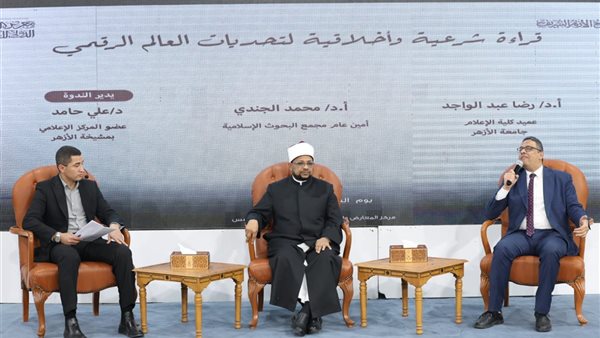
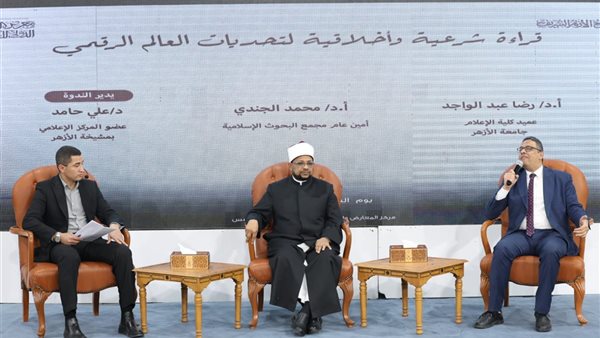
This came during his participation in a symposium on a legal and ethical reading of the challenges of the digital world, organized by the Al-Azhar Pavilion within the activities of the Cairo International Book Fair, in the presence of a number of scholars, thinkers, and those interested in issues of contemporary thought and digital transformation.
He explained that the concept of moral sovereignty is one of the most important issues raised today, stressing that the absence of borders in the digital space does not mean the absence of values, and that Sharia has established an ethical system capable of regulating the human relationship with technology, in a way that achieves a balance between freedom of use and moral responsibility.
The Secretary-General addressed the issue of artificial intelligence, noting that it represents a tool for human development, but it should not be turned into an alternative reference to reason or conscience, stressing that the legal balance in dealing with it is based on employing it in what serves people and enhances their religious and humanitarian awareness, without leading to the marginalization of values or distortion of concepts.
Regarding the protection of children and adolescents, he stressed that legalizing the use of smart phones is no longer an option, but rather a legal and educational necessity, aiming to preserve the mind and time, which are among the overall goals of Islamic law, warning of the negative effects of excessive use of digital media on the psychological and intellectual structure of new generations.
He also stressed that privacy in Islam is an inherent right that does not lapse with changing media, explaining that digital blackmail and violating personal secrets represent a double assault: legally and morally, because they involve revealing the cover, harming oneself, and threatening social stability.
The Secretary-General touched on social responsibility in publishing and commenting on digital platforms, indicating that the written word is no less influential and dangerous than the spoken word, and that bullying and electronic defamation are modern forms of injustice forbidden by law, calling for establishing a culture of awareness and self-accountability in dealing with digital content.
Regarding intellectual security, His Eminence explained that fortifying the Islamic identity in the digital age is not achieved by prevention or isolation, but rather by building a conscious human being capable of discrimination, strengthening value affiliation, and interacting positively with what is presented on the platforms without melting down or closing down.
At the conclusion of the symposium, the Secretary-General called for the adoption of a digital ethical charter that will be a reference for every user of technology, stressing that the simple ethical question: “Does this behavior satisfy my religion and conscience?” It must remain present before every publication or interaction, so that technology remains a means of construction and not a tool of demolition.