

Tuesday 16 December 2025 – 01:19 PM
What is known as the Jerusalem Airport Plan represents one of the most dangerous episodes of Israeli settlement expansion in the vicinity of Jerusalem, not only in terms of its urban size, but also because of its decisive geographical location and its long-term political function.
Jerusalem airport plan
The issue here is not related to an ordinary construction project, but rather to a deliberate attempt to reshape the city’s vital space and impose demographic and geopolitical realities that will be difficult to reverse in the future.
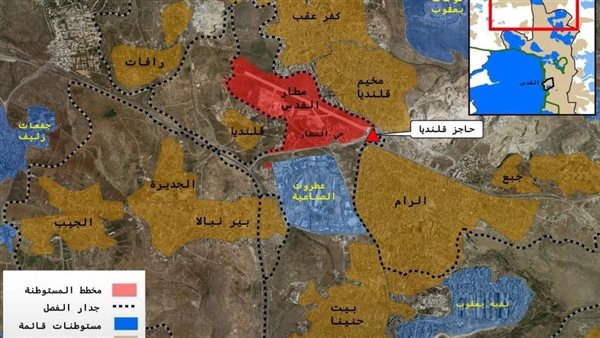
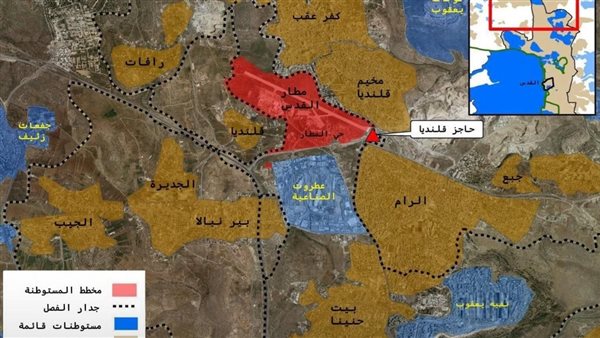
The plan is located in the area surrounding Jerusalem Airport, formerly known as Qalandia Airport, north of the city, between Jerusalem and Ramallah.
This area constitutes a central node between northern and central Jerusalem, and is adjacent to dense Palestinian communities such as Qalandiya, Kafr Aqab, Al-Ram, Al-Jib and Al-Jedira.
It also extends along the separation wall and the Qalandiya checkpoint, making it a de facto control point for Palestinian movement north of Jerusalem.
These characteristics give the site exceptional strategic importance, as controlling it means controlling the last geographical corridors linking Jerusalem to its natural Palestinian surroundings in the West Bank.
According to circulating data, the plan aims to establish a large settlement on the airport lands and its surroundings, which includes about 9,000 settlement units, in addition to integrated infrastructure and modern road networks.
These roads are not designed to serve the region only, but also to connect it to the existing settlements north and east of Jerusalem, ensuring their full integration into the Israeli settlement fabric.
The map associated with the project clearly reveals that the goal is not to establish an isolated settlement, but rather to build a geographically connected settlement bloc that penetrates the Palestinian neighborhoods, practically separating Jerusalem from its northern Palestinian extension, and turning the neighboring villages into isolated and besieged islands.
This plan goes beyond the urban dimension to reach the heart of the conflict over Jerusalem. The primary goal is to perpetuate the Judaization of the city and change its demographic balance by encircling Palestinian neighborhoods and stifling their natural growth.
The project also seeks to cut off urban and human communication between Jerusalem and Ramallah, in a move that strikes the geographical basis of any connected Palestinian entity.
Politically, the Jerusalem Airport Neighborhood Plan constitutes a direct blow to any future perception of East Jerusalem as the capital of a Palestinian state.
The project reinforces the policy of imposing a fait accompli, using “planning and construction” tools as a legal cover for a systematic colonial process, implemented quietly but with far-reaching effects.
The bottom line is that what is happening in the vicinity of Jerusalem Airport is not just a new settlement expansion, but rather a redrawing of the political map of the city across geography.
It is a project that aims to resolve the conflict over Jerusalem through land, roads and housing, before any possible negotiations, in one of the most dangerous attempts to establish an irreversible reality around the most sensitive city in the Palestinian-Israeli conflict.