

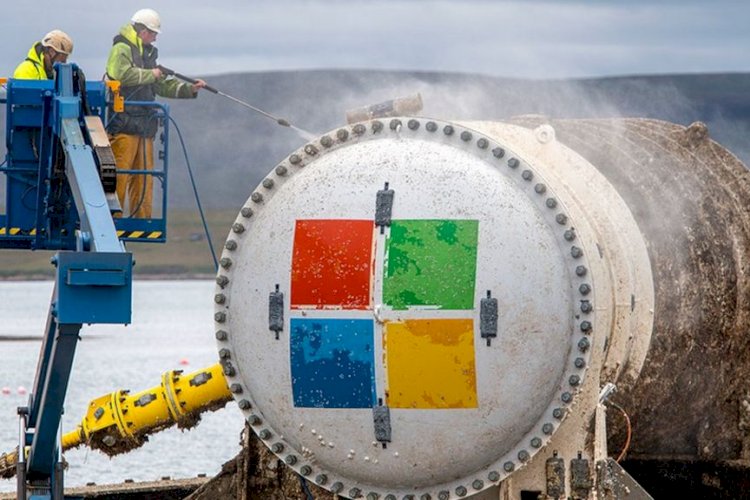
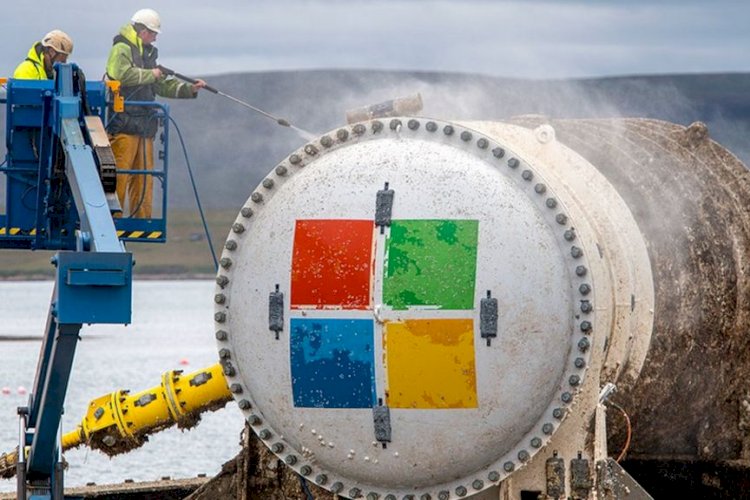
In 2018, Microsoft sunk an entire data center to the bottom of the Scottish Sea, sinking 864 servers and 27.6 petabytes of storage 117 feet into the ocean. Today, the company reported that its latest experiment was a success, revealing results that show the idea of an underwater data center is actually a very good one.
On the surface, dumping an entire data center at the bottom of the ocean may seem strange, but Microsoft’s Project Natick team hypothesized that placing the data center would result in more reliable and efficient data centers.
On Earth, data centers face issues such as corrosion from oxygen, moisture, and controlling temperature shifts. But in a water-tight environment with tight temperature control, far fewer problems arise. The idea is that these types of servers can be easily deployed in large and small sizes near the coasts of areas that need them, providing better local access to resources based in more places.
The benefits are significant. Microsoft says the underwater data center had only one-eighth the failure rate of a terrestrial data center, which is a huge improvement. This low failure rate is important, since it is very difficult to service a downed server when it is in a sealed container on the ocean floor.
The company had been exploring experimenting with the idea of underwater servers for some time in 2015, when a data center off the coast of California was submerged for several months. This round of experiments took a long time, with the goal of proving that the company could accomplish this task on a practical scale that could be manufactured and produced for real-world use.
Microsoft has confirmed that the next goal of Microsoft’s Project Natick team is to demonstrate the possibility of removing and recycling servers easily once they reach the end of their lifespan.
Source: theverge