

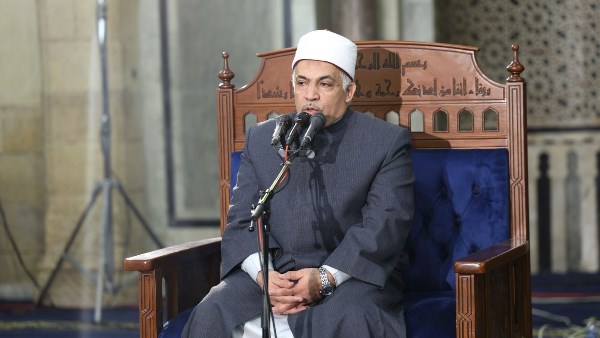
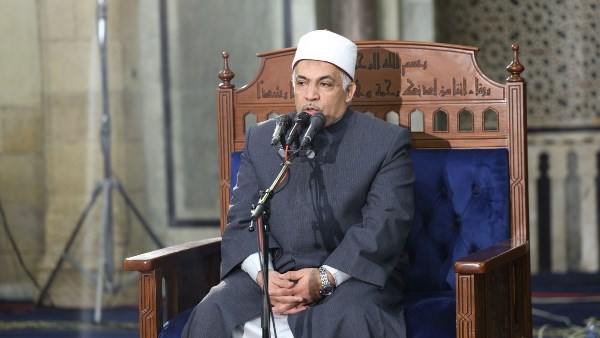
Dr. Ramadan Al-Sawy, Vice President of the University, confirmed Al-Azhar Today, Saturday, in the Tarawih lesson at Al-Azhar Mosque on the fourth night of the blessed month of Ramadan of the year 1447 AH, Lower Egypt said that fasting is not only abstinence from food and drink, but rather a “call for change” in a Muslim’s life, a change in habit, worship, morals, and behavior.
He explained that God Almighty referred to the purpose of fasting in His Almighty saying: “O you who have believed, decreed upon you is fasting as it was decreed upon those before you that you may become righteous,” indicating that the transition from breaking the fast to fasting By God’s command is practical training on a person’s ability to change his habits and abandon what he is accustomed to if it conflicts with God’s command, which should apply to all other bad habits that a person is accustomed to.
He pointed out that fasting opens wide doors to increase faith and renew the connection with God, citing the words of the Prophet, peace and blessings be upon him: “Whoever fasts Ramadan out of faith and in seeking reward, his previous sins will be forgiven,” and his saying: “Whoever observes Ramadan out of faith and in seeking reward, his previous sins will be forgiven,” stressing that the night prayer in Ramadan is a practical opportunity to increase faith, as God Almighty said: When God is mentioned, their hearts fear, and when His verses are recited to them, it increases them in faith. Hearts.
He explained that fasting is a call to change morals and control behavior, citing the words of the Prophet, peace and blessings be upon him: “Fasting is a shield. If it is a day for one of you to fast, let him not be obscene, immoral, or ignorant. If anyone curses or insults him, let him say, ‘I am fasting.’” Likewise, his saying, peace and blessings be upon him, “Whoever does not give up false speech and acting upon it, God has no need for him to give up his food and drink,” indicating that true fasting is the one whose effect is reflected on the tongue. And the limbs and transactions.
He also emphasized that one of the greatest things that fasting fosters is respect for time and discipline, as God Almighty has set for the fasting person a time in which abstinence begins and a time in which it ends. God Almighty said: “And eat and drink until the white thread becomes distinct to you from the black thread. dawn, then complete the fast until nightfall,” indicating that this precise definition is a call to adhere to appointments and perform responsibilities with perfection.
The Vice President of Al-Azhar University concluded the lesson by emphasizing that Ramadan is a school for change for the better, and that whoever invests it well will emerge from it with a better heart, upright behavior, and a stronger relationship with God Almighty, asking God to make us among those accepted.