


Thursday 01/January/2026 – 11:55 AM
The Sohag National Museum displays the piece for the month of January 2026, coinciding with the celebration of International Education Day, corresponding to January 24th of each year, as part of its cultural and educational role aimed at highlighting the value of science and knowledge and their impact on building civilizations.
Sohag National Museum displays a unique artifact during the month of January
This occasion comes to recall the pioneering role of ancient Egyptian civilization, as after the unification of the two countries, Egypt witnessed the establishment of the first state and central government that the world had ever known, which led to political and economic stability that contributed to the prosperity of intellectual life and the beginning of an educational renaissance that was the nucleus of the greatest civilizations of the ancient world.
The administration of the Sohag National Museum said in a statement that the ancient Egyptian realized the importance of documentation and recording events, so he invented writing in the ancient Egyptian language with its three scripts. Hieroglyphics, which was known as the sacred script and was inscribed on the walls of temples and tombs, and hieratic, which was used in government offices and schools inside temples, then Demotic, which was known as the most abbreviated popular script.
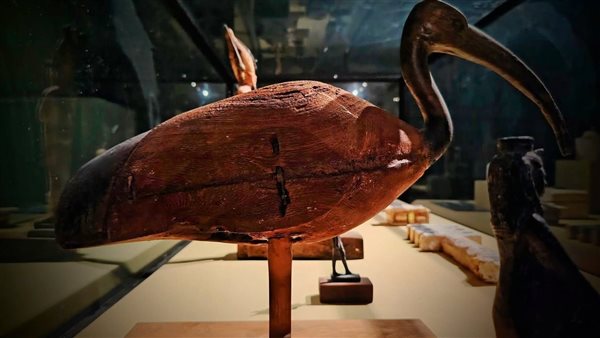
Writing and knowledge in ancient Egyptian thought were linked to the deity “Jahuti,” also known as “Thoth,” the deity of wisdom and knowledge, whose ancient Egyptian symbol was the ibis bird, as a symbol of thought, blogging, and the protection of knowledge.
On this occasion, the museum presents a “statue of the epis bird,” made of wood and bronze, dating back to the Greco-Roman era. It is considered one of the sacred birds of the ancient Egyptians, as its sanctification began since the Early Dynastic Era, embodying the position of science and writing in Egyptian civilization throughout the ages.