


Thursday 26/February/2026 – 07:07 AM
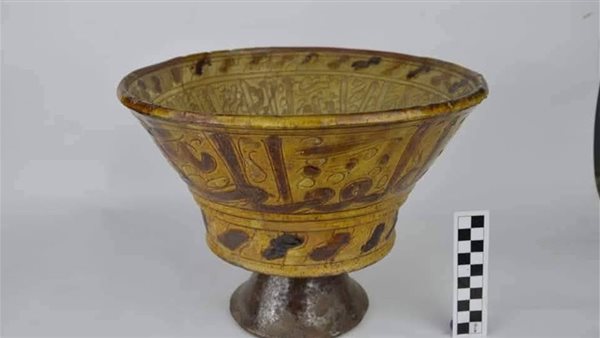
The Luxor Museum of Ancient Egyptian Art announced the display of distinctive pottery vessels dating back to the Mamluk era. This vessel is a unique example of applied arts in the Mamluk era during the fourteenth century AD. It is characterized by a cup-shaped body made of painted pottery, and its inner surface at the rim is decorated with a band of repeating geometric decorations. Below it is a band of writings executed in Naskh script, from which it reads: “From what he has done that is drawn for the sake of the respected, the most dear, the most honorable Badr al-Din Ezz.” – Victory and acceptance.
Luxor Museum of Ancient Egyptian Art highlights Mamluk vessels
The outer surface of the vessel also bears another strip of inscriptions in Naskh script, in which it is stated: “From the work of the poor, the honor of the Iwani is the servant of all people.” However, the last two words were distorted and incomplete as a result of the limited space allocated for the inscription.
The writings appear on the outer surface in brown, while the inner writings are executed in yellow, and are decorated with repetitive decorative units underneath. The base of the vessel is painted in honey color, while its bottom bears a decorative “ring” that takes the form of a circle with a square inside it, which is a decorative element that reflects the distinctive artistic character of that period.
The display of this piece comes within the mission of the Luxor Museum of Ancient Egyptian Art, which aims to shed light on the treasures of Egyptian heritage and enhance visitors’ awareness of the importance of language as a living record of human civilization and a bridge linking the past to the present.