


Thursday 05/February/2026 – 01:38 AM
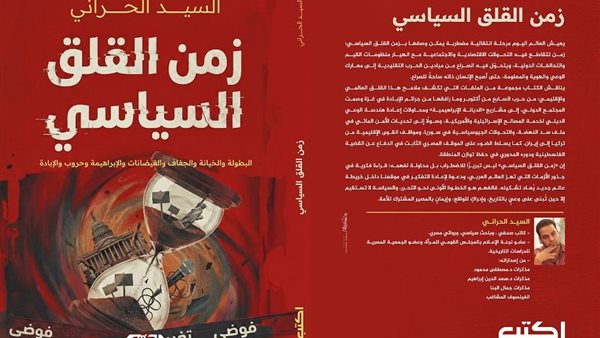
The first part of the book The Time of Political Anxiety – Heroism, Betrayal, Drought, Floods, Abraham, and Wars of Extermination, by journalist and political researcher Mr. Al-Harrani, was published in 230 pages.
The book comes as an attempt to understand a global moment of crisis, in which anxiety is no longer just a passing psychological state, but has turned into a governing structure for international relations, and an integral component in shaping the collective consciousness of peoples, especially in the Arab region and the Middle East.
The book starts from a central premise that the world is experiencing a stage of complex anxiety that goes beyond the boundaries of traditional conflicts between countries, extending to conflicts over awareness, identity, information, and religion, where humans are no longer merely a side victim of wars, but rather have themselves become the primary arena of conflict. The battle, as the author puts it, is no longer waged solely with tanks and planes, but rather with discourse, narrative, and the restructuring of concepts.
Regarding anxiety as a political and moral phenomenon, the book addresses anxiety as a political and moral phenomenon at the same time, not just a reflection of a state of instability. Al-Harrani believes that anxiety reveals the fragility of existing political structures, and exposes the absence of major projects capable of producing meaning or a horizon for the future. In this context, he links the escalation of environmental crises, such as drought, floods, and climate change, with direct threats to water and food security, considering that these crises are not only natural disasters, but rather direct results of a world system that is defective in its priorities and values.
The book also deals with contemporary wars and armed conflicts, not as separate events, but as links in a single chain that reshapes the balance of international power, and at the same time reveals the inability of international law and its institutions to protect vulnerable peoples, under the logic of power and interests.
Regarding Abrahamism and the re-engineering of consciousness, the author devotes a remarkable analytical space to discussing what is known as the “Abrahamism” project, which he sees as a political and cultural project that goes beyond declared religious discourse, and aims in essence to re-engineer religious and cultural consciousness in the Middle East after the failure of sectarian dismantling projects. In this context, Al-Harrani emphasizes that the anxiety discussed in the book should not be viewed as a sign of weakness, but rather as a revealing state of awareness, saying:
“Anxiety, in its essence, is not inability, but rather evidence that conscience is still alive. The problem is not anxiety, but rather turning it into silence or complicity.