


Monday 16/February/2026 – 10:49 PM
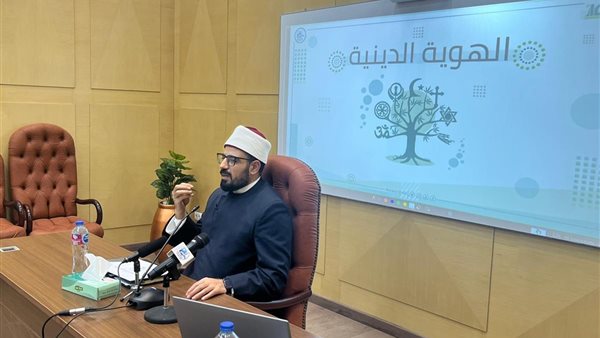
The Egyptian Fatwa House held a scientific lecture entitled “The Great Existential Questions,” delivered by Sheikh Taher Zaid, Director of the “Hiwar” Unit at the Egyptian Fatwa House, as part of the activities of the fourth symposium organized by the Training Department of the Fatwa House under the title: “Religious Identity and Youth Issues” at the House’s headquarters in Cairo, under the patronage of His Eminence Professor Dr. Nazir Muhammad Ayyad, Mufti of the Republic, Head of the General Secretariat for the Roles and Fatwa Bodies in the World.
Director of the Dialogue Unit at Dar Al-Iftaa: The three big questions: Where did I come from, where am I going, and what is my job? It is the key to shaping awareness
The lecture activities began with a welcome speech delivered by His Eminence Sheikh Muhammad Mabrouk Al-Shilani, Director of the Training Center at the Egyptian Fatwa House, in which he welcomed the audience, stressing the importance of raising intellectual issues that affect young people’s awareness and religious identity in light of contemporary challenges. The opening also included a blessed Qur’anic recitation, read by His Eminence Sheikh Ahmed Al-Awadi, Director of the Dispute Resolution Department at the Egyptian Fatwa House, while His Eminence Sheikh Ahmed Bassiouni, Director of the Imam Al-Layth Bin Saad Center for the Jurisprudence of Coexistence, moderated the session and presented its activities.
In the lecture, the Director of the Dialogue Unit at Dar Al-Iftaa addressed the issue of religious identity from a cognitive and rational angle, linking the legal text to the major existential questions that shape a person’s awareness of himself and the world around him. He began his lecture with the hadith of the Prophet, may God’s prayers and peace be upon him and his family: “The parable of one who adheres to the limits of God and who falls within them is like a people who took part in a ship,” explaining that this hadith establishes a deep understanding of the concept of salvation, stressing that salvation in this world is not achieved individually in isolation, but rather is a collective survival based on endurance. Shared responsibility, and that leaving a mistake unaddressed does not threaten the individual alone, but rather exposes the entire society to destruction. He gave an example of the story of a historian whose traditional lifestyle prompted him to search for the truth. He traveled to India because of its religious and philosophical diversity. When he asked about the most knowledgeable people, he was referred to as a man worshiping on top of a mountain. When he asked him about the truth of existence, he answered that it was reduced to two concepts, but he had forgotten them.
The director of the Hewar Unit stated that what combines this story with the Prophet’s hadith is “forgetting,” not in the sense of losing information, but rather forgetting the meaning and purpose, considering this a major entry point to understanding the identity crisis. He moved on to explain how religious identity is formed, defining identity as matching what is in the mind to what is outside, that is, the harmony of internal perceptions with practical reality.
He also addressed the concept of religion through the participants’ contributions, highlighting the difference in their definitions according to their different perspectives and experiences, which indicates – according to him – that the perception of religion may be affected by the personal context if it is not controlled by a clear cognitive approach, stressing that the formation of identity takes place only through a person’s confrontation with three major existential questions: Where did you come from? Where should I go? What is my job in this life? Stressing that these questions are not abstract theories, but rather practical, in the light of which human choices, behavior, and outlook on the universe and life are determined.
In a related context, he posed a central question about how the Muslim world thinks about life and existence, explaining that thinking begins with research into the origin of existence: How did man exist? And who found it? Then he moves on to realize the principle of causality as a basis for understanding the universe, indicating that whoever created the universe must be characterized by obligatory qualities, including survival, immortality due to his contradiction with accidents, existence of the soul, and oneness, as it is rationally impossible – as he said – for the needy, the variable, or the multiple to be the origin of existence, pointing out that one of the sources of knowledge is the sense, enumerating the five senses, and that human knowledge is integrated and not limited to one source, addressing the three dimensions of man: his relationship with himself, and his relationship with himself. With his social environment, and his relationship with the universe around him, explaining that any belief or philosophy that is unable to answer one of these dimensions, or provides a confused or incomplete answer, cannot be a correct religion. Because true religion presents an integrated conception of man and existence.
He addressed the issue of proving the existence of God, citing the Almighty’s saying: “Or were they created without anything, or are they the creators?”, indicating that the verse establishes a conclusive rational argument for the impossibility of man’s existence without a Creator. He also presented the proposal of some historians about the beginning of the universe, and that it was a single mass and then an explosion occurred from which the universe was formed in its current form. He asked: Who created this mass? What are the factors that led to its explosion? How did this cosmic expansion occur with such precision and regularity? To confirm that the logical answer requires the existence of a knowing, wise, and capable force, which indicates that this universe has a perfect Creator.
At the conclusion of the lecture, the director of the dialogue unit reviewed the quadripartite rational division to explain existence, explaining that the mind must settle on one of four possibilities: that existence arose from nothing, or that nature created man, or that man created himself, or that a compelling external force created him, indicating that the first three possibilities are rationally invalid, and all that remains is acknowledging the existence of one Creator, All-Powerful, All-Knowing, All-Wise, through whom the existential vision is established, and religious identity is formed on a correct basis, within a framework of awareness. Al-Rashid, which the Egyptian Fatwa House seeks to establish among young people.