

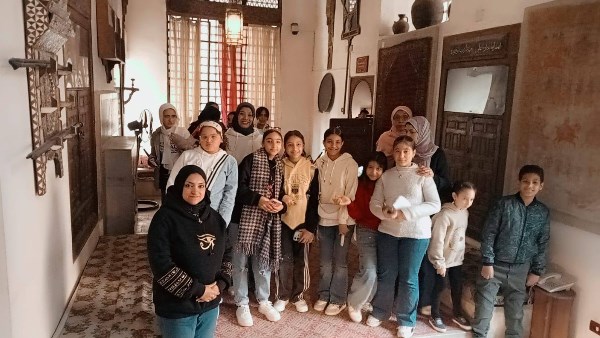
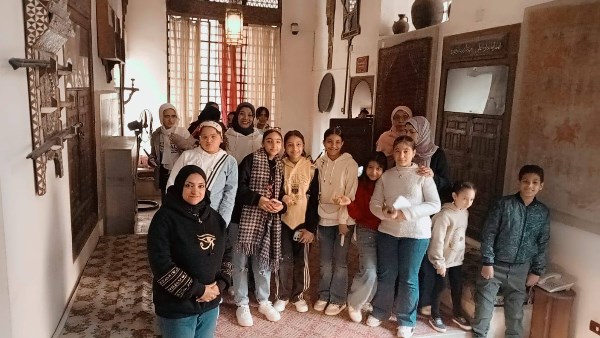
The Gayer Anderson Museum celebrated International Tourist Guide Day by welcoming a group of male and female students from the Sayyida Zainab and Al Khalifa Educational Departments.
The management of the Gayer Anderson Museum explained that the students enjoyed a visit to the museum halls to learn about the history of the two houses and the most important archaeological collections, in addition to a workshop on telling the legends of Cretelia, and a workshop entitled The Little Guide.
Gayer Anderson Museum
It is noteworthy that the Gayer Anderson Museum, also known as the Al-Kritliya House, is located in Ahmed Ibn Tulun Square in the Sayyida Zeinab neighborhood, and it consists of two houses dating back to the Ottoman era. The first house belongs to its owner, the teacher Abdul Qadir Al-Haddad, who established it in 1631, while the second house was built by Hajj Muhammad bin Salem bin Jalmam Al-Jazzar in 1540, and they are an example of Egyptian homes during the ages. The two houses combine elements of architecture from the Mamluk and Ottoman eras, and both were known as the “House of Creteliya,” in reference to the last family to reside in them, which was one of the families coming from the island of Crete.
The English officer, Gayer Anderson Pasha, submitted a request to the Committee for the Preservation of Arab Antiquities in 1935 to rent the two houses on the condition that he restore them and furnish them in the Islamic style and display in them his archaeological collection of ancient Egyptian and Islamic antiquities, as well as his collectibles dating back to eras and civilizations from different countries, including India, China, Turkey, Iran, England, and Damascus, with the condition that this furniture and his collection of antiquities would become the property of the Egyptian people after His death or when he leaves Egypt permanently, and the two houses are converted into a museum bearing his name.
The museum consists of 29 halls distinguished by their wooden ceilings decorated with floral and geometric decorations. The museum also contains a path with a well. Among the museum’s most famous halls is a group of specialized halls, including Indian, Chinese, Andalusian, Damascene, Persian, Byzantine, and Turkish, each of which contains furniture of the same style as the name of the hall, in addition to the birth and bridal halls.
The museum also includes a group of halls that follow the architecture of the house, including the Haramlek, the Salamlek, the men’s winter and summer halls, and the celebration hall, in addition to a group of newly developed halls such as the Bab al-Kritliya and Masterpieces of al-Kritliya halls.