


Sunday 25/January/2026 – 04:57 AM
The French scientist Jean-François Champollion is considered one of the greatest linguists and Egyptologists in history, as he was able to decipher Egyptian hieroglyphs, laying the foundation for understanding ancient Egyptian civilization. Champollion was born in 1790, and from a young age he showed an unusual interest in languages, so much so that at the age of 16 he spoke at the Grenoble Academy about the Coptic language, which he believed was close to the language of ancient Egypt.
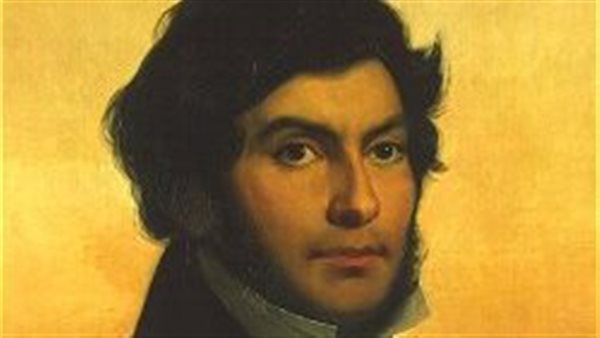
Jean-François Champollion…the man who decoded the Egyptian hieroglyphs
In 1807, he studied under Sylvester de Sacy at the Colleg de France, where he later held the chair of Egyptian history and Egyptian antiquities from its establishment in 1831 until the end of his life, being the first to hold this position. During his years of study, Champollion delved into many languages such as Arabic, Chinese, Coptic, and Persian, which enabled him to build a broad knowledge base that helped him decipher the Rosetta Stone.
In 1822, he published his famous book, “The Discourse of Med. Dassé,” in which he explained the foundations of the ancient Egyptian language, and he was able to correctly identify half of the hieroglyphic letters, before later developing his ideas based on the rules and dictionary of the language.
In 1824, Champollion visited the museums of Turin, Livorno, Rome, Nabeul, and Florence, and then became curator of the Egyptian collection at the Louvre Museum in Paris. He also visited Egypt between 1828 and 1829 with a working team to prepare a systematic description of Egyptian antiquities, which contributed to documenting the Pharaonic civilization in an accurate scientific manner. Champollion died in 1832, leaving a huge scientific legacy, which made him a global symbol in the study of the ancient Egyptian language, and a key to understanding the secrets of the Pharaonic civilization that remained a mystery for many centuries.