
Thursday 19/March/2026 – 09:56 AM
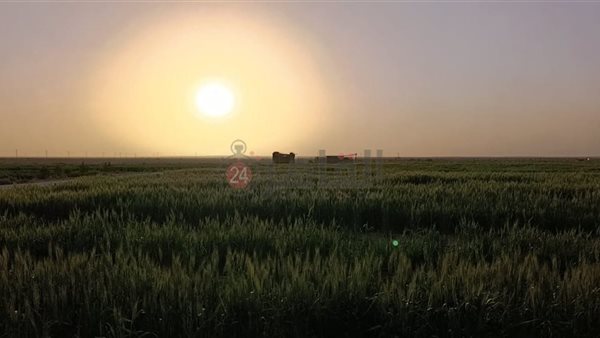
In the heart of the development clusters in central Sinai, where the features of an integrated project begin to emerge, in which education, agriculture and health intersect under the umbrella of the state’s plan for the comprehensive development of the Land of Turquoise. The outskirts of the desert extending in the heart of central Sinai are no longer a reality as some claim, as they are cut off by development clusters that seem like new oases sprouting in the middle of the void… The road there is long, strewn on both sides by silent mountains, but behind this calm are the stories of those who decided to start over in houses lined up… Order, small olive fields cutting through the sand, schools and health units bear witness to a serious attempt to transform the harsh geography into a space of hope.
On its trip to central Sinai, Cairo 24 monitors the most prominent features of the story in a field visit that began in a school, moved to fields and service centers, and then concluded inside a health unit that works day and night, to reveal how the new life is taking shape there.
From inside Al-Joufah School for Basic Education, affiliated with the Al-Hasana Educational Administration, Ahmed Salem, Director of the Administration, receives visitors, confirming that the school includes kindergarten, primary, and preparatory stages, and is currently operating in the primary and preparatory stages with a number of 115 students.
He explained that the school serves the Jadiya area and the surrounding communities, as there are 4 schools serving the entire area, in addition to the Omar bin Al-Khattab Industrial School for Technical Education in the mother village.

Salem pointed out that the majority of schools in these areas were established under the supervision of the East Canal Anti-Terrorism Forces Command, within the framework of supporting the infrastructure of the education sector, as the state was interested in raising the efficiency of schools and equipping them with modern laboratories and equipment, to be at the level of their counterparts in cities.
He talked about the transformation witnessed by the local community, explaining that modern education contributed to raising awareness within the tribes, and models of Bedouin children began to appear who achieved advanced levels of education.
He added that one of the biggest challenges was the long distances between villages and schools, as some villages were 20 or 30 kilometers away without means of transportation, which prevented students from attending, but with the establishment of schools within the communities, the educational service became available without suffering.
He pointed out that the problem of teacher shortages witnessed a significant improvement, as a percentage ranging between 75% and 90% of the deficit was filled, which was reflected in the quality of the educational process compared to previous years. He also pointed out that there is a special incentive for remote areas of up to 300%, to motivate teachers and workers to continue serving in these areas.
16 agricultural clusters…an integrated project for life and stability
From the school, the visit moved to the agricultural clusters, where we met Dr. Imad Awad, the general coordinator of the Agricultural Clusters and Service Centers Project in Sinai at the Ministry of Agriculture and Land Reclamation, who explained that the project began operating 16 agricultural clusters in North and South Sinai, benefiting 1,122 families, with each family receiving five acres and a house within the cluster.

He stressed that the nature of each cluster differs in terms of water and soil, and therefore the Desert Research Center is responsible for determining the appropriate crop composition for each area. The project relies entirely on a modern irrigation system using groundwater, with a focus on the olive crop as a main crop due to its suitability to the local environment and the possibility of maximizing added value through oil extraction.
He stressed that the farmer within the cluster is committed to the specific crop structure, commensurate with the nature of the climate and soil in each region, whether in the north, center or south, to ensure achieving the best productivity.
Agricultural service centers with a “one-stop” system
Awad pointed out that the state was not satisfied with distributing land, but rather established three integrated development service centers in Al-Nasila in Central Sinai, Al-Hasana in North Sinai, and Sahel Al-Qaa in South Sinai, to serve agricultural communities and their surrounding areas.
He explained that each center is located on an area of 10 acres, and includes a building for agricultural extension and capacity development, where farmers receive theoretical and practical lectures to raise their efficiency, especially since many of them came from the valley with a different agricultural culture. The center also includes a cooperative agricultural society for dispensing fertilizers, and a complex of laboratories for analyzing soil, water, and plants, to provide service within the region instead of moving to other governorates.

He added that the center also includes a modern olive press that will be operated as the trees enter their third year, to maximize the added value of the product, in addition to an agricultural mechanization unit that provides equipment at a 50% discount on the actual cost, a unit for producing olive seedlings distributed free of charge to farmers, and outlets for selling approved agricultural supplies. It also includes a residence building and a rest area for research teams and trainees.
“From Dead Ghamr to Al-Nasila”… the story of a beneficiary who chose to start over
Inside one of the fields, we met Karim Abdel Hadi, one of the beneficiaries of the Al-Nasila Gathering Project since 2021. He said that he came from Mit Ghamr Al-Ahliyya after applying for the project and winning the land, stressing that the land began to bear fruit by planting olives and loading them with barley and cumin, due to its tolerance of drought conditions.
He explained that the gain is not large at first, but it covers the costs and provides a stable source of income, as independence in a house and spacious land gives him a better chance for his children’s future compared to life in the valley, pointing to the availability of basic services such as schools and health units, as development continues.

The tour concluded inside one of the health units, where we met Zainab Muhammad Abdel Ghani, a supervisor and nurse at the Al-Hasna Health Department, who confirmed that the unit provides vaccination, reception, emergency, and laboratory services, and that some units are equipped with x-ray machines and operate 24 hours a day with a shift system.

She explained that the crew includes nurses, doctors, and laboratory technicians, some of whom are from the region and others reside in rest houses designated for them. An ambulance is also available to transport cases to Nakhal or Al-Arish hospitals when needed.
She added that the unit implements presidential initiatives such as “Mother and Fetus,” and provides examinations for pregnant women that include hemoglobin and sugar levels and early detection of risk factors, in addition to health education for mothers about the importance of vaccinations and preventive care, in a society that previously lacked sufficient awareness of these services.

Between a modern school inside a Bedouin community, an olive farm that relies on modern irrigation, and a health unit that works non-stop, the picture of central Sinai seemed different from what people were accustomed to… The picture there reveals that development is no longer a promise, but rather a reality that is gradually taking shape through education, agriculture, and health, in a project aimed at stabilizing the population and building a stable society in the heart of the desert, where the development communities turn into a living model of the idea of stability through the gate of development.