

Wednesday 17 December 2025 – 10:44 AM
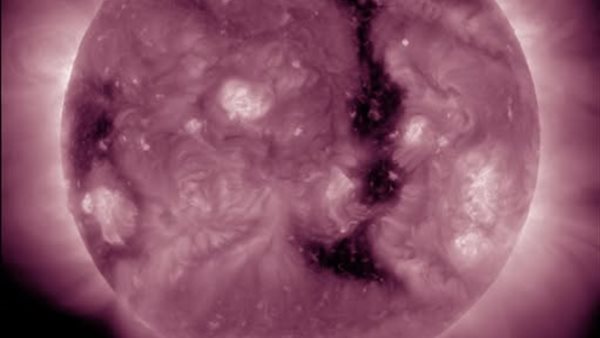
Satellites dedicated to observing the Sun have detected the presence of a large coronal hole in the outer atmosphere To the sun It is characterized by an extended structure resembling a valley or deep gully, and is currently facing directly toward Earth. Ultraviolet observation images show that this coronal hole releases an active stream of high-speed solar wind toward Earth.
Observing a huge hole in the sun’s atmosphere
According to the Astronomical Society in Jeddah, space weather models, this solar wind is expected to reach the Earth’s magnetic field on December 18, 2025, which may lead to the occurrence of G1 geomagnetic storms on the geomagnetic storm scale.
The Astronomical Society explained that coronal holes are areas in the solar corona where the density of plasma decreases and the magnetic field lines in them are open towards space, unlike the magnetically closed active regions. This open hole allows the flow of solar wind at speeds higher than the usual rate that may exceed 500 kilometers per second. When these holes are directed directly towards the Earth, the possibility of the solar wind interacting with the planet’s magnetosphere increases, leading to geomagnetic disturbances whose intensity varies depending on the wind speed, its density, and the direction of the accompanying magnetic field.
Category G1 storms are classified as relatively weak and are not expected to pose a direct threat to terrestrial infrastructure. However, some limited impacts may be recorded, most notably minor disturbances in high-frequency radio communications, minor fluctuations in satellite navigation systems, and enhanced opportunities for observing the aurora borealis in areas near the polar circles.
The potential impact of this solar phenomenon on the Arab world is very weak to almost non-existent, because the region is located within the medium and low latitudes, where the strong effects of magnetic storms do not usually reach, and since the expected storm is of the G1 category, it is considered scientifically weak, as it will not result in electrical outages or significant disturbances in communications or aviation. It also does not pose any health risk to humans, and its impact, if any, is limited to minor technical fluctuations monitored by specialized devices without the general public being aware of them.