
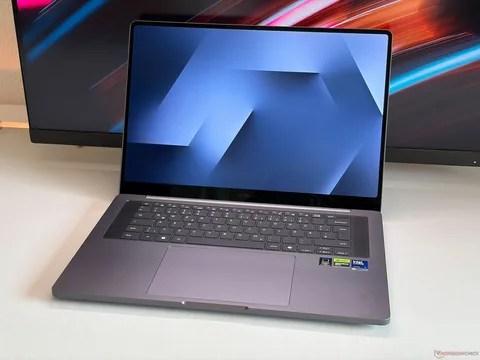
Despite Samsung’s position as one of the world’s largest suppliers of OLED displays, its laptop displays were not able to compete strongly in terms of brightness levels during 2025. This weakness was clearly evident in last year’s Galaxy Book 5 models, as despite providing a dazzling visual impression with a refresh rate of 120 Hz, the brightness remained limited to approximately 400 nits in SDR content and about 550 nits in SDR scenarios. HDR as seen on the Galaxy Book 5 Pro 360.
Samsung seeks to change this stereotype through the all-new Galaxy Book 6 Ultra computer, which has undergone recent tests. This pioneering version saw the use of a significantly improved 16-inch OLED touch screen, continuing to provide the same superior display resolution of 2880 x 1800 pixels along with a smooth refresh rate of 120 Hz to ensure a comfortable visual experience for the eyes.
The real upgrade in this generation centered around significantly improving brightness levels to enhance the enjoyment of viewing and use. The new measurements showed the screen’s ability to reach about 500 nits when displaying SDR content, while it made a huge leap by exceeding the maximum brightness barrier of 1,100 nits when playing HDR content, which led to a significant improvement in the appearance of movies and games and made them vibrant in an unprecedented way.
But when you put this progress against the scale of fierce competition, it becomes clear that the company was only able to narrow the gap without outperforming its opponents. The new screen is still unable to compete with the latest tandem OLED screens, which record up to 1,600 nits in devices such as the Asus ProArt P16 and Lenovo Yoga Pro 9i, and the MacBook Pro 16 computer from Apple also maintains its overwhelming superiority thanks to the Mini-LED screen that reaches 1,000 nits in SDR mode and 1,600 nits in HDR mode.
This scene raises legitimate questions about the company’s neglect of using more efficient tandem OLED screens in its flagship computer dedicated to multimedia for the year 2026. Although reviewers emphasized the great quality of the current picture and its absence of any optical distortion or graininess resulting from the touch layer, the high cost of this computer makes it an additional step ahead of competing companies, something that is difficult to overlook when making a purchasing decision.