

Millions of dollars enter the country and there is not a single unemployed young man.. The village of Grace.. is an Egyptian village that was able to make pottery to reach international level, financed and supported by the United Nations.. and European countries compete for its products.. I wonder what is the story of this village?
In the heart of Menoufia Governorate, specifically the center of Ashmoun, there is a village called Grace. It is a simple village, but what happens inside it is much larger than its size. Grace is not just an ordinary Egyptian village. This is a place where pottery was born, raised, grew, and became an industry that brings in hard currency to the country, and its name is known throughout Egypt.
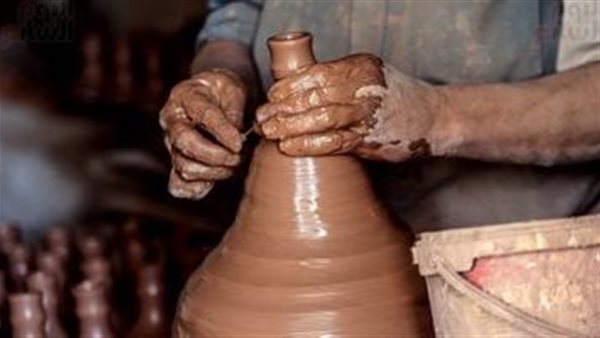
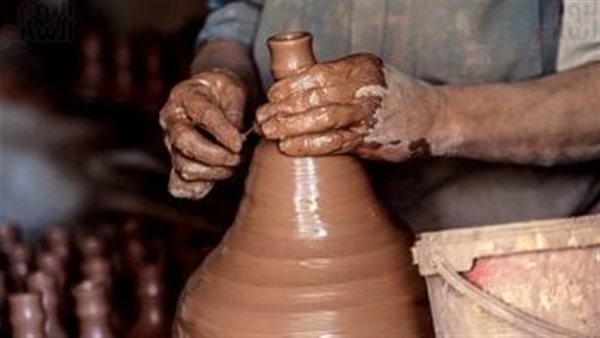
As soon as you enter Grace, you notice that pottery there is not an individual profession, it is a complete system of life. There is almost no house in the village without a workshop inside it, and not a workshop for display. A workshop is working all day long. The clay is shaped into the wheel, the fire is burning, and from the hands of the villagers, pottery comes out in large quantities every day.
The village alone includes more than 200 pottery workshops, including large workshops specialized in production and preparation for export, and small workshops inside homes that complete the chain. This number makes Grace one of the largest and oldest pottery making centers in all of Egypt, a profession passed down from generation to generation, and the primary source of income for hundreds of families.
What distinguishes it is that its production does not stop at the local market, and a large portion of the pottery tools that are made in the village are exported abroad according to demand, especially to Arab countries. This is precisely what made a small village in Menoufia remain an essential party in the movement to export authentic Egyptian handicrafts and contribute to introducing hard currency to the Egyptian economy.
Although pottery is an ancient industry, it has been able to keep pace with the times. The world began to look at the village as a rare model. That is why the United Nations Industrial Development Organization specifically chose Grace and considered it the pottery castle in Egypt.
The support provided was not formal, but it worked to develop the industry itself from its core by training dozens of families working in pottery to improve the aesthetic appearance and modern designs so that the Egyptian product prefers to maintain its identity and at the same time compete internationally.
This transformation moved it from a mere craft village to a global production village with the same thinking as Egyptian clay and the same hands, but with an export mentality and an international market. An industry that faced challenges such as the spread of plastic and the difficulty of marketing, but it remained steadfast because the entire village stood behind the profession and adhered to it.
Today’s Grace is a clear example that the world does not need huge factories or giant industrial cities. It needs a village that believes in itself and its heritage and is able to transform it into real economic value. A small Egyptian village that started from clay and reached the world and preferred to preserve its identity while entering its name and its country’s economy into the arena of international competition.