
Saturday 22/November/2025 – 12:24 PM
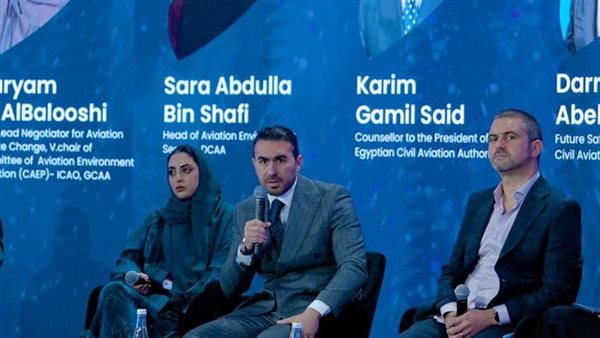
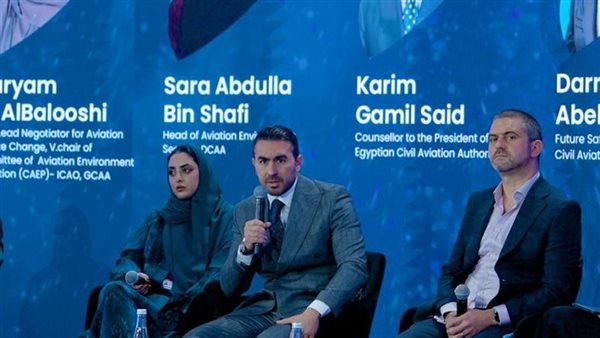
The Dubai Airshow 2025 witnessed the holding of one of the most prominent sessions specialized in aviation and sustainability policies, entitled “Overcoming Regulatory Fatigue, Global Laws and Regional Realities,” within the Aerospace 2050 Sustainability Conference, with the participation of an elite group of representatives of aviation authorities from the region and the world.
With a pioneering national and legislative vision.. Egypt highlights its regional presence in the session on harmonizing global laws with regional reality within the Dubai Aviation activities
Senior experts and officials participated in the session, including the representative of Egypt, Pilot Karim Jamil, Advisor to the Chairman of the Egyptian Civil Aviation Authority, the Innovation and Future Safety Officer at the United Kingdom Civil Aviation Authority, Engineer Maryam Al Balushi, the UAE’s main negotiator in the aviation climate change file, and Ms. Sarah Abdullah, Head of the Aviation Environment Department at the Dubai Civil Aviation Authority, while the session was moderated by Ms. Farah Mesmar, Director of Sustainability for the Middle East and North Africa Region at the International Air Transport Association (IATA).
The session discussed the increasing challenges resulting from the complexity of global regulations and ways to harmonize them with the capabilities and needs of each region, in addition to examining mechanisms for exchanging experiences between countries and the challenges associated with harmonizing international requirements with national capabilities and the requirements of economic growth.
During the dialogue, the representative of Egypt, Pilot Karim Jamil, explained that from a legislative standpoint, Egypt has integrated international obligations within the national aviation system directly and comprehensively, ensuring that its legislation is fully aligned with the standards of the International Civil Aviation Organization (ICAO), by including all requirements and best practices within the regulatory framework and supervision and inspection mechanisms. This was clearly demonstrated in the update and submission of the Second National Action Plan for the Aviation Sector for the year 2025 to ICAO, which confirms Egypt’s full commitment to achieving the long-term global goal of aviation, through main axes, the most important of which are operational efficiency improvements, enhancing airport infrastructure, developing operational capabilities for air navigation and environmental systems, and activating a unified measurement and reporting system.
Pilot Karim Jamil added that this trend is integrated with the Ministry of Civil Aviation’s strategy to promote and develop all activities in accordance with the highest international standards and sustainable development requirements, which contributes to improving the international classification of Egyptian airports and raising their readiness to comply with modern global requirements.
He also stressed that the sustainability of airports and supporting infrastructure represent one of the most important priorities of the Ministry of Civil Aviation, as Egyptian airports have recently achieved international achievements that reflect real work on the ground, most notably Cairo International Airport receiving the Leadership in Sustainability Award as the largest airport in Africa from the Airports Council International (ACI), in addition to Hurghada International Airport achieving zero waste.
In the context of enhancing operational sustainability, he pointed out that Egypt has positioned itself today as a leading and promising country in the field of producing sustainable aviation biofuel (SAF) in Africa and the region, through its national project to produce sustainable fuel through ESAF with a production capacity of 120 thousand tons annually, which is an ambitious project that enhances Egypt’s ability to support neighboring countries in meeting global sustainability requirements in the aviation sector.
Egypt is also working, in cooperation with the International Civil Aviation Organization (ICAO) and the Global Environment Facility (GEF), to implement pioneering projects, most notably the project to develop the firefighting system and gradually eliminate PFAS materials at Cairo and Sharm El-Sheikh international airports, and replace them with environmentally friendly alternatives. This project reflects Egypt’s deep commitment to applying the highest international environmental standards, and contributes to enhancing operational sustainability and raising the readiness of Egyptian airports, which is directly reflected in improving its international classification.
With these integrated efforts, Egypt continues to consolidate its position as a rising regional power in the field of sustainable aviation, capable of transforming international commitments into an actual reality implemented on the ground at airports. With continued investment in infrastructure, the integration of modern technologies, and the strengthening of international cooperation, the country is moving steadily towards a more efficient, safe and sustainable future of aviation, which embodies Egypt’s Vision 2030 and places it at the forefront of countries supporting the green transformation in the global aviation sector.