

Sunday 23/November/2025 – 12:55 PM
Dr. Nazir Muhammad Ayyad, Mufti of the Republic, Head of the General Secretariat of Fatwa Houses and Bodies in the World, confirmed that the Egyptian Fatwa House, throughout its extended history, was – and still is – a fundamental pillar in spreading moderate moderate thought, correcting misconceptions, enhancing religious and societal awareness, and confronting extremist thought, deriving its approach from the moderation of Al-Azhar Al-Sharif and its established values.
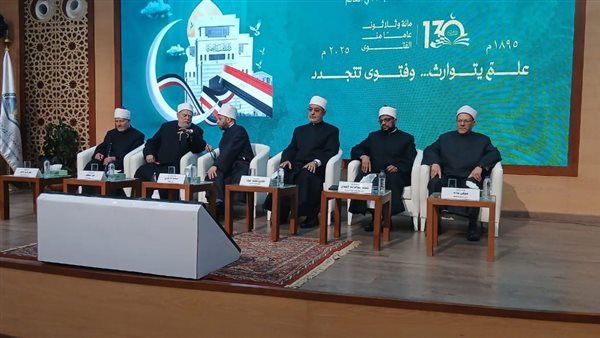
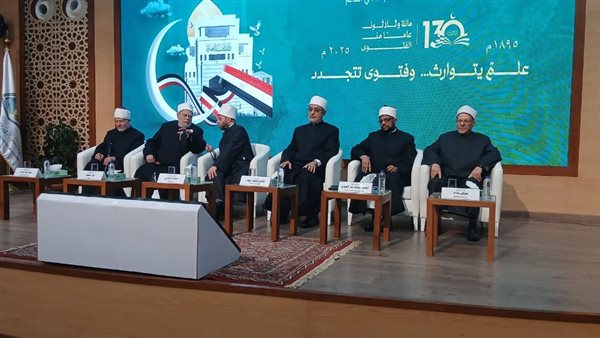
This came during the speech delivered by His Eminence at the opening session of the celebration of the Egyptian Fatwa House on the occasion of the 130th anniversary of its founding, in the presence of a number of ministers and leaders of Al-Azhar Al-Sharif, the Ministry of Endowments, and men of thought, culture, media, and civil society.
The Mufti: We faced extremist religious and non-religious thought… and we look forward to a rational fatwa future despite the challenges of globalization and artificial intelligence.
During his speech, His Eminence the Mufti reviewed the beginning of who assumed the position of issuing fatwas, pointing out that the Noble Prophet, may God’s prayers and peace be upon him, was the first to assume this position, and he was issuing fatwas with the inspiration of God Almighty, and his fatwas were “the most comprehensive of the rulings that included the separation of discourse. Then the Companions and the Noble Household, may God be pleased with them, assumed fatwas after him, who were distinguished by their depth of knowledge, sincerity of faith, and good eloquence, and then this trust was transferred after them to the followers.” Such as Saeed bin Al-Musayyab, Ata bin Abi Rabah, and others who were permitted by the major companions to issue fatwas.
His Eminence the Mufti of the Republic explained that the eight schools of jurisprudence were established in the Islamic nation after that, including the four Sunni schools of thought: Hanafi, Maliki, Shafi’i, and Hanbali, and the Shiite schools of Imami, Zaidi, Ibadi school of thought, and Zahiri school of thought. They were crystallized in schools of law with origins and rules, and their imams and senior scholars took over fatwas throughout the ages, stressing that the modern era witnessed the transformation of fatwas into an official institution with its own system. And its administrative and scientific structure, and the Egyptian Fatwa House was the pioneer of fatwa institutions in this field.
His Eminence the Mufti stressed that the celebration of the 130th anniversary of the founding of the Fatwa House is an occasion to recall its great heritage, which has become a jurisprudential and cognitive treasure from which researchers and scholars can draw, due to its original methodology that balances the legal texts with the requirements of reality, thereby achieving the purposes and honors of the Sharia. He pointed out that the Fatwa House throughout its history has embraced great sheikhs and muftis who were a chosen elite and an elite chosen by God Almighty. They held the fatwa secretariat, and worked to consolidate societal stability and spread the values of tolerance and coexistence, in addition to their national role in confronting extremist thought, exposing its deviations, and repelling attempts to tamper with the Egyptian identity, which combines religious and national affiliation.
Ayyad: Since its inception, Dar Al-Iftaa has been keen to be an extension of the correct Islamic approach
His Eminence the Mufti of the Republic added that when the Fatwa House reaches its one hundred and thirty year anniversary, this long period does not appear as preserved history, but rather as a witness to an experience that was able to combine unchangeable origins and unstable facts, with a sound approach that does not search for innovation in its form but rather in achieving its scientific and purposeful requirements, indicating that the Fatwa House, since its inception, has been keen to be an extension of the correct Islamic approach and balanced thought, and has sought to confront extremist thought. Both religious and non-religious, it has also remained a national entity that shares the hopes and pains of the Egyptian state, and contributes to its civilizational renaissance by highlighting the moderate fatwa as a tool for building and developing societies.
His Eminence the Mufti pointed out that the Egyptian Fatwa House has become – thanks to God – an “international and global entity” that seeks to spread moderate thought and the sound methodology for making fatwas through the General Secretariat of Fatwa Houses and Bodies in the World, which was established in 2015, and which has become a locomotive in the face of misguided and deviant fatwas.
In his vision for the future of Dar al-Ifta, His Eminence the Mufti stressed that we are anticipating a new phase in which the challenges of globalization and artificial intelligence are increasing, praising the efforts of all sectors of Dar al-Ifta and its employees, and affirming his support for them on the path to a rational fatwa future. He concluded his speech by emphasizing that the celebration of the 130th anniversary is not just a historical occasion, but rather “a moment in which the fatwa reviews its position among the people,” stressing that “constancy does not mean stagnation, and change does not mean “The fatwa is valid only with solid knowledge, penetrating insight, and patience that distinguishes between permanent interest and temporary need.
The ceremony was attended by His Excellency Prof. Dr. Osama Al-Sayed Al-Azhari, Minister of Endowments, and His Excellency Prof. Dr. Ashraf Sobhi, Minister of Youth and Sports, Eng. Mohamed Shimi, Minister of Business Sector, Dr. Ibrahim Saber, Governor of Cairo, Eng. Adel Al-Najjar, Governor of Giza, Eng. Hatem Nabil, Head of the Central Agency for Organization and Administration, Mahmoud Al-Sharif, Head of the Supervision Syndicate, and His Eminence Prof. Dr. Muhammad Abdel Dayem Al-Jundi, Secretary-General of the Islamic Research Academy, and His Excellency Prof. Dr. Ali Jumaa, member of the Council of Senior Scholars, former Mufti of the Republic, and His Eminence Prof. Dr. Nasr Farid Wasel, member of the Council of Senior Scholars, former Mufti of the Republic, and His Eminence Prof. Dr. Shawqi Ibrahim Allam, the former Mufti of the Republic, and Dr. Salama Dawoud, President of Al-Azhar University, Reverend Dr. Andre Zaki, Head of the Evangelical Community, a number of ambassadors, and a group of Al-Azhar and Endowment scholars, and men of thought, culture, media, and civil society.