

Sunday 08/March/2026 – 11:11 PM
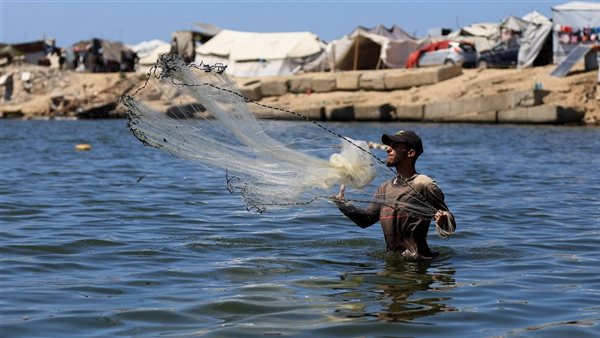
The fishing sector lives in a sector GazaA state of complete collapse under the weight of the Israeli siege, forcing Palestinian fishermen to risk their lives daily to obtain small quantities of fish.
Fishermen face death to make a living amidst a stifling siege
The Washington Post explained, in a report, that fishermen row their rickety boats only approximately 200 meters off the port of Khan Yunis to escape the reality of displacement and try to fish.
The Washington Post quoted 72-year-old Palestinian fisherman Daoud Suhail, who was displaced from the city of Rafah in May 2024 as a result of the Israeli war, that Israel has always restricted their freedom at sea even before October 2023.
Daoud Sahwail explained that the fishing areas approved by the Oslo Accords in 1993 were not actually implemented, but were constantly shrinking without warning. He pointed out that he lost his small boat and his nets after they were destroyed by Israeli forces days before his displacement, and six large fishing boats belonging to Rafah fishermen were completely destroyed.
Because of this destruction, fishermen are now forced to use parts of refrigerators as floating boards, and rely on hand paddles in the absence of engines to escape death.
On a statistical level, Zakaria Bakr, head of the Fishermen’s Syndicate in Gaza, told the Washington Post that the sea has become practically closed to fishermen who are afraid to exceed 800 meters from the shore due to the blurring of the permissible distances.
According to another Reuters report, the Gaza Fishermen’s Syndicate reported that Israeli forces have killed at least 238 fishermen since October 2023, whether at sea or on land, out of more than 72,000 Palestinians who lost their lives. The union added that even after the ceasefire began in October, more than 20 fishermen were killed or arrested.
Daoud Sahwail confirmed that Israeli naval forces shoot at boats or arrest fishermen based on the mood of the soldiers, while Zakaria Bakr stressed that Israel prevents the entry of equipment and refuses to allow the return of safe and stable working conditions for fishermen.
The report stated that before the war, this sector included more than 5,000 fishermen who supported about 50,000 members of their families as proof of the vitality of this sector.
Regarding food security, another Al Jazeera Network report cited statistics issued by the United Nations indicating that the fishing sector was operating at less than 7.3 percent of its previous production capacity by the end of 2024.
The United Nations estimated that 72 percent of the fishing fleet in Gaza was damaged or completely destroyed, and that reducing the permitted fishing area to less than one nautical mile led to a radical reduction in the quantity and diversity of fish, with fishing often limited to small sardines.
According to the latest report, as a result of this collapse, markets in Gaza currently depend on imported frozen fish, which is sold at exorbitant prices beyond the capacity of families whose destroyed boat hulls have been turned into supports for tents in displacement ports.