

The executive authorities in the city of Hawamdiya, Giza Governorate, succeeded in seizing an unlicensed factory for manufacturing biscuits inside a warehouse operating under conditions extremely dangerous to public health.
This is based on the directives of Engineer Adel Al-Najjar, Governor of Giza, and the instructions of Ibrahim Al-Shehabi, Deputy Governor of Giza, to intensify oversight of food establishments and confront unlicensed activities.
The discovery of the incident came as Ahmed Saber, Director of the Shop Licensing Department, and Saber Ali, Director of the Evening Shift in the Occupancy Department, passed by. They noticed unusual industrial activity inside a warehouse, and they immediately notified Engineer Abdel Khaleq Farag, Chairman of the Hawamdiya City Council.
Immediately upon receiving the report, the city head moved to the site immediately, accompanied by Hossam Mohamed, deputy head of the city, Tariq Abu Al-Dahab, director of the Environment Department, Mohamed Jumaa Abu Suleiman, head of the local unit of the village of Umm Khanan, Abdel-Wahab Abdel-Rahim, director of the Occupations Department, Engineer Mahmoud Faraj, director of the Engineering Department, Musaad Kassab, director of field follow-up, Yasser Al-Boushi, deputy of field follow-up, Mohamed Abu Al-Dahab, and Adham Abu Salama, engineering department.
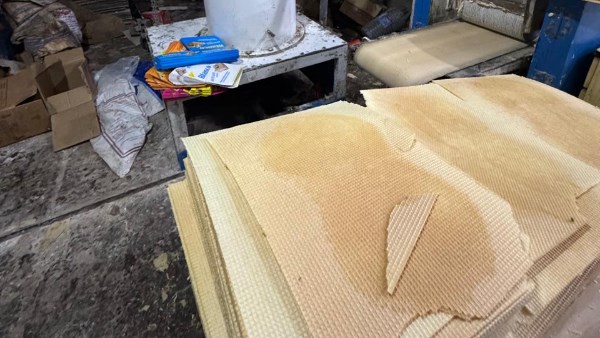
It turned out that the place was a warehouse equipped with biscuit production machines, which were primitive production lines that were fully operational without any licenses or compliance with food safety requirements. It was also proven that the process of storing the final product before packing took place inside the same production site, in a polluted environment, as quantities of biscuits appeared lying on the ground directly next to dust and waste, in addition to the absence of any health certificates for workers or quality control of raw materials.
Immediately, the Health and Supply Departments were notified, and Osama Al-Jazzar, Director of the Hawamdiya Supply Department, and Dr. Ahmed Mohamed Heiba, Director of the Food Control Department, moved to conduct the examination and take the necessary measures. Samples of raw materials and finished products were withdrawn to conduct the necessary analyzes in approved laboratories.
The city president also stressed the continuation of intensive campaigns on all food factories and stores, while applying the maximum legal penalties on violators, in order to preserve the health and safety of citizens.
In the end, the entire factory was closed and waxed, the raw materials, finished products and equipment inside the site were seized, and the necessary reports were issued against the violators, with an emphasis that the monitoring campaigns are continuing and any activity that violates or threatens public health will not be tolerated.