
The Ministry of Education and Technical Education announced the harvest of the academic year 2025, as the Ministry paid special attention to developing teachers’ capabilities and professional skills in line with the developed curricula and the requirements of modern education. The Ministry launched the Development Ambassadors Program and the program targeted the subject year wave, in addition to a number of teachers to be the nucleus for training their colleagues in the directorates, in cooperation with UNICEF.
The training programs targeted 100% of teachers via the video conference network. The training programs also included learning communities launched by development ambassadors and also included 100% of teachers for the second time as supportive training, and holding a specialized course for teachers that targeted how to deal with integration students according to the developed curricula.
Continuing efforts to build new classrooms and rehabilitate and develop existing schools
The Ministry of Education and Technical Education continued to implement its strategy to accelerate the construction of new schools and rehabilitate existing schools, as well as continuing to implement comprehensive and urgent maintenance in a way that contributes to improving the quality of educational services and solving the problem of densities in classrooms, according to the approved timetables and in line with national priorities, while giving priority to the villages most in need.
In this context, the General Authority for Educational Buildings continues to implement the plan to expand the construction and development of school buildings, to meet the needs of various types of education. During the period from 1/7/2024 until now, it has achieved tangible achievements in the field of construction and development of school buildings, as (791) projects with a total of (13,912) classrooms were completed and delivered at the level of the governorates of the Republic.
In addition, (830) projects with a total of (14,611) chapters are currently being implemented, while studies have been completed and (361) projects with a total of (5,735) chapters have been proposed and are being awarded, which reflects the continuing pace of work to meet the needs of future expansion.
These projects were implemented in all governorates of the Republic according to the priorities of need and availability of land, and contributed directly to reducing class densities, reducing the multiplicity of school periods, and serving the areas most in need, while meeting the requirements of all types of education and educational stages.
The authority also paid special attention to the expansion of Egyptian-Japanese schools, as 14 new schools were introduced in the current academic year, and 10 schools are being prepared to be launched next academic year.
The efforts also included the expansion of schools for those excelling in science and technology, as (3) new schools were established during this period, in addition to the implementation of (7) schools that are currently underway, in support of caring for gifted and scientifically distinguished students.
With regard to equipping schools, all projects that have been implemented have been completed, in parallel with the Ministry’s plan to replace 500,000 school beds, as (385,000 school beds) have been supplied so far.
Development, efficiency raising, and various maintenance works were also carried out for (3,085) schools nationwide during this period.
Based on the directives of the Minister of Education and Technical Education, and within the framework of urgent solutions to confront densities and achieve stability in the educational process, the programs for implementing maintenance plans were modified to take place during the end-of-year and half-year vacations and weekly vacations, especially for urgent maintenance work, in a way that ensures that studies are not disrupted.
As part of the expansion of applied technology schools, the Authority has developed a number of (5) schools, and the necessary measures are being taken to develop about (100) other schools, to support modern technical education and link it to the labor market.
Efforts also included developing and raising the efficiency of some administrative buildings and converting them into school buildings in the areas most in need, to contribute to reducing densities and ending school periods.
Advanced architectural models were also prepared for general education schools and Egyptian-Japanese schools, based on the directives of His Excellency the Minister and his observations during his field tours in various governorates of the Republic.
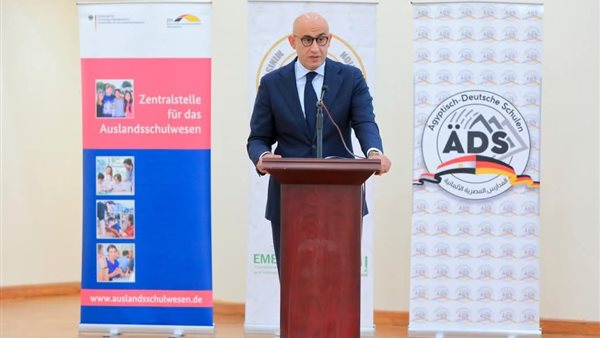
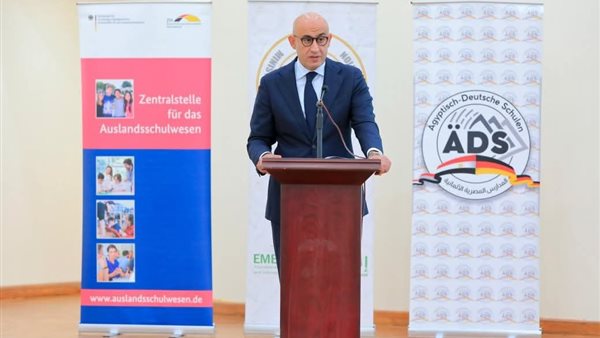
The Egyptian-German Schools Project was launched with the opening of the first school in October City
In a qualitative step that reflects the Egyptian state’s orientation towards developing the education system and adopting world-leading educational models, the year 2025 witnessed the historic launch of the Egyptian-German schools project, as it is one of the most important axes of educational cooperation between the Arab Republic of Egypt and the Federal Republic of Germany in the field of pre-university education.
The Ministry of Education and Technical Education announced the opening of applications for the first batch of Egyptian-German schools for the academic year 2025/2026, marking the start of implementation of the project, which aims to establish 100 Egyptian-German schools distributed across various governorates during the coming years, ensuring the availability of educational services in multiple regions and reaching the largest possible segment of students.
The project is implemented within the framework of a strategic partnership with the German Embassy in Cairo, and with the support of the Goethe-Institut and the central administration of German schools abroad, ensuring the transfer of leading German expertise in educational administration and curriculum development, while fully preserving the Egyptian national identity.
This cooperation embodies the depth and strength of Egyptian-German relations, and confirms the status of education as one of the basic pillars of strategic cooperation between the two countries, as Egyptian-German schools offer an integrated educational model starting from kindergarten to secondary school, and relying on modern educational concepts that focus on quality, developing critical thinking, and building students’ practical skills.
These schools combine international educational standards with developed Egyptian curricula, achieving a balance between openness to different cultures and preserving cultural specificity and Egyptian identity, with the German language being a basic subject within the study plan, which opens new horizons for students to communicate with an additional culture and language.
The Egyptian-German schools project represents a qualitative shift in the Egyptian education system, embodying the state’s orientation towards investing in the quality of education and building Egyptian people capable of competing regionally and internationally.
Opening 14 new Egyptian-Japanese schools this academic year
In light of the directives of the political leadership to apply the Japanese experience in education and adopt successful international models, the year 2025 witnessed a remarkable development in the Egyptian-Japanese Schools Project, which represents one of the most prominent models of educational cooperation between Egypt and Japan. This year represented an important turning point in the course of the project, as it moved from the stage of limited experimentation to a comprehensive national expansion plan that reflects the state’s commitment to developing education and building a generation capable of keeping pace with the requirements of the future.
The 2025-2026 academic year witnessed the opening of 14 new Egyptian-Japanese schools, bringing the total number of schools to 69 schools distributed across the various governorates of the Republic, in parallel with preparations for 10 new schools to enter service during the next academic year 2026-2027 as a first phase, with continued expansion to bring the number of Egyptian-Japanese schools to 500 schools in accordance with presidential mandates.
Opening of 4 new international public schools (IPS).
Within the framework of the Egyptian state’s strategy to develop education and provide educational alternatives with international standards, the International Public Schools (IPS) achieved notable achievements during the year 2025 that reflect the commitment of the Ministry of Education and Technical Education to expanding educational models that represent shining models in Egyptian education.
The state’s public school model witnessed a remarkable expansion, as the number of international public schools (IPS) nationwide reached 31 schools, with 4 new schools entering service for the academic year 2025-2026 in the governorates of Menoufia, North Sinai, Cairo and Fayoum.
The international public schools project aims to provide international education with advanced standards and reasonable expenses, while subjecting teachers and trainers to evaluation tests that guarantee the quality of the educational service provided in these schools.
Expansion of STEM schools…and their students take first places in local and international competitions
The year 2025 has witnessed intensive steps by the Ministry of Education to expand schools for those excelling in science and technology (STEM). Al-Arish and Al-Buhaira schools were opened for those excelling in science and technology, bringing the number of schools to 23 schools in 20 governorates, equipped with the latest laboratories to care for those excelling in science and technology.
STEM school students took first place in a number of local and international competitions during the current year to continue their excellence, as the students won 31 gold medals, 66 silver medals, and 152 bronze medals in various Scientific Olympiads.
STEM students also won second and fourth place in the ISEF International Competition in Ohio, USA, in addition to winning a bronze medal in the International Robot Olympiad in Singapore, and winning second place globally in the International Olympiad for Creativity in Science in Indonesia.
Students from schools for excellence in science and technology won a silver medal in the Genius Olympiad at the Rochester Institute of Technology in New York and fifth place in the Arab Olympiad for Artificial Intelligence in the Kingdom of Saudi Arabia. They also won a gold medal in the Arab Olympiad for Mathematics in Qatar.
At the local level, STEM students won the top five places in the Cairo Water Week Young Inventors Competition, won first places in the National Innovators Competition, and won first place in the Egyptian Computer Science Olympiad.
Launching the National Program for the Development of Arabic Language Skills to improve the reading and writing skills of basic stage students
Within the framework of interest in developing basic reading and writing skills among students, the Ministry of Education and Technical Education launched in February 2025 the National Program for Developing Arabic Language Skills, as an urgent response to the fundamental gap in reading and writing skills, as these skills represent the cornerstone of children’s development and the transition from learning to read to reading for learning.
The first phase included implementing a pre-test targeting 500,000 students from the third to sixth grades of primary school in 10 governorates, and 10,000 teachers were trained on the training package through the professional platform for teachers, based on the basic evaluation report for the fourth grade that was conducted in October 2023.
The results of the program resulted in a significant positive impact in improving levels of reading, comprehension and educational achievement, with positive feedback from parents. The implementation of the program continued from February until the end of May 2025, with it being circulated to the first and second grades of primary school for students who passed the initial and final exams during the period from May to September 2025.
The second phase, which was launched in 10 other governorates and is currently being implemented, targets more than 426,042 students.
Unprecedented efforts to support people of determination…and the launch of intellectual education curricula for the first time for the kindergarten stage in cooperation with 5 Egyptian universities and UNICEF.
The current and last academic year witnessed unprecedented procedural steps to support people of determination and improve the education system provided to them, as the year 2025 witnessed the launch of intellectual education curricula for the kindergarten stage for the first time, in cooperation with five Egyptian universities and UNICEF. Completely new curricula were prepared for students of intellectual education schools that take into account the students’ mental abilities, and keep pace with the modified general education curricula, in order to achieve integration between the general education system and inclusive education.
This development included holding workshops during the period from February to June 2025, in cooperation with UNICEF, and with the participation of an elite group of university professors and education experts.
These efforts resulted in the preparation of books for the first and second grades of kindergarten, in addition to the preparation of books for the first, second and third grades of Arabic, English and mathematics, ensuring an integrated educational progression that suits the needs and abilities of students.
A teacher’s guide for life skills and motor skills for intellectual education schools was also prepared, in addition to preparing a guide directed to parents of integrated students with disabilities in general and technical education schools, to support the partnership between the school and the family.
Within the framework of supporting educational personnel, a specialized training course was implemented for teachers targeting how to deal with integration students according to the developed curricula. The training included 25,574 teachers, counselors, psychologists and social workers, 307,090 kindergarten teachers, 15,988 mathematics teachers, 12,001 science teachers, and 82,750 Arabic language teachers, which enhances teachers’ readiness. To implement new curricula with high efficiency.
This project reflects the Egyptian state’s commitment to developing the inclusive education system and providing a fair and comprehensive educational environment that meets the needs of all students and ensures their effective integration into society, in accordance with the latest international educational standards.
Relaunching the Egyptian Reyadah International Center to Empower People with Special Needs on the 10th of Ramadan with a new vision and global expertise
Within the framework of the efforts of the Ministry of Education and Technical Education to provide all means of support to our children with special needs, the Ministry of Education and Technical Education has developed and raised the efficiency of the Egyptian Reyadah International Center to Empower People with Special Needs on the 10th of Ramadan, and transformed it into an integrated global edifice.
The year 2025 witnessed the relaunch of the center with a new vision that included the use of Japanese expertise specialized in supporting and empowering people with disabilities, strengthening the partnership with the Italian side, and expanding specialized services so that the center includes 18 departments, including physical and occupational therapy, sensory integration, psychological and behavioral rehabilitation, music and art therapy, and specialized medical clinics.
The center’s data was also linked to the national education system, and intensive training courses were organized for teachers and specialists on the latest international assessment tools.
Close cooperation with civil society organizations to equip and operate resource rooms to serve students with minor disabilities
The Ministry continued its efforts to enhance close cooperation with civil society institutions to support the comprehensive education system and expand resource rooms to serve students with minor disabilities, as the number of resource rooms reached 933 rooms in 20 governorates, and 400 additional rooms are being prepared.
Resource rooms provide a specialized educational environment equipped with supportive educational tools and means, which contributes to developing the academic and social skills of students with minor disabilities. Civil society organizations cooperate with the Ministry of Education to finance the furnishing of the rooms, and the Ministry also trains teachers and specialists to manage them and prepare individual educational plans.