

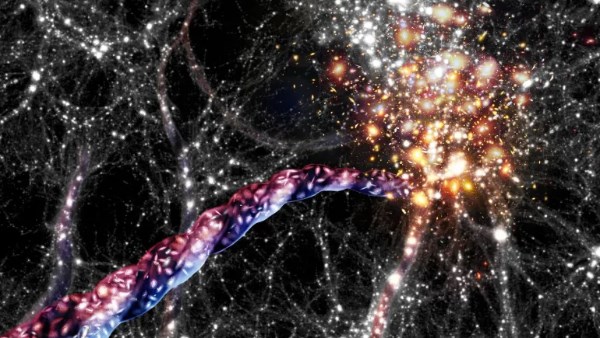
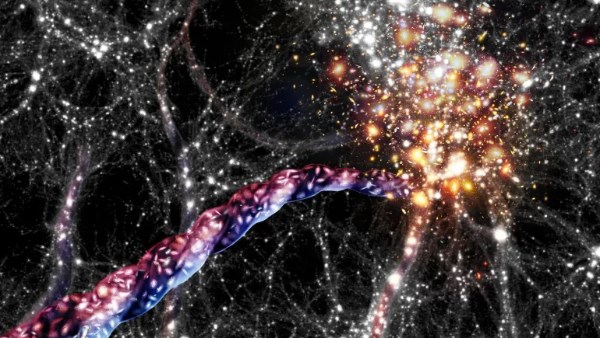
In an astonishing astronomical discovery, an international team led by researchers from the University of Oxford has observed a massive cosmic structure that is one of the largest rotating structures known to date.
This structure consists of a thin line of galaxies extending over millions of light-years, and is located about 140 million light-years from Earth.
The results of the study were published in the journal Monthly Notices of the Royal Astronomical Society, providing new insight into how galaxies acquire their rotation over time.
Double rotation baffles older models
What is new about this discovery is that the cosmic thread does not only include galaxies revolving around themselves, but rather that the entire structure revolves as a single unit, a phenomenon that has never been observed with such clarity before.
Researcher Leila Young explains that the true distinction does not lie in size alone, but in the synchronization between the rotation of galaxies and the rotation of the filament itself.
The scene can be likened to a revolving platform in an amusement park, where the cups rotate individually while the entire platform rotates at the same time.
The data showed that the direction of rotation of most galaxies within the string is not random, but rather coincides with the direction of rotation of the cosmic structure, which challenges traditional models that assume that torque is generated locally during galaxy formation.
Does the universe impose its movement on galaxies?
This alignment points to the possibility that the “fabric of the universe” itself transfers angular momentum to the galaxies, rather than their motion arising independently. If confirmed, it could open the door to a deeper understanding of how large cosmic structures arise and evolve.
Cosmic threads, the hidden arteries of the universe
Cosmic threads are among the largest known structures, and they form what is known as the “cosmic web,” which is an enormous network of matter, including dark matter, that extends throughout space and through which galaxies and gases flow.
Scientists believe that these filaments represent a fossil record of ancient cosmic flows, as tracking the movement of gas and galaxies within them helps to understand how galaxies grow and acquire their dynamic properties.
The researchers focused on galaxies rich in hydrogen gas, as it is the primary fuel for star formation. Studying its distribution reveals how matter flows from cosmic threads into galaxies, influencing their structure and star formation rates in them.
Unprecedented monitoring techniques
The discovery was based on a combination of advanced observational techniques, most notably data from the MeerKAT radio observatory in South Africa, which includes 64 interconnected dishes. These observations came within a deep sky survey known as “MIGHTEE.”
The team also integrated visual data from international astronomical projects, which made it possible to draw an integrated picture of the structure and determine its rotational movement with unprecedented accuracy.
Researchers confirm that this type of discovery is no longer possible except through broad international cooperation that brings together multiple experiences and advanced technologies.
An open-ended cosmic question
This discovery is not limited to setting a new record in the size of cosmic structures, but rather it re-asks a fundamental question in cosmology: Are galaxies formed from the inside out, or is the larger cosmic structure imposing their movement from the beginning? The answer to this question may change our understanding of how the universe itself was formed, and open a new chapter in the study of its deepest secrets.