

Tuesday 17/February/2026 – 04:01 PM
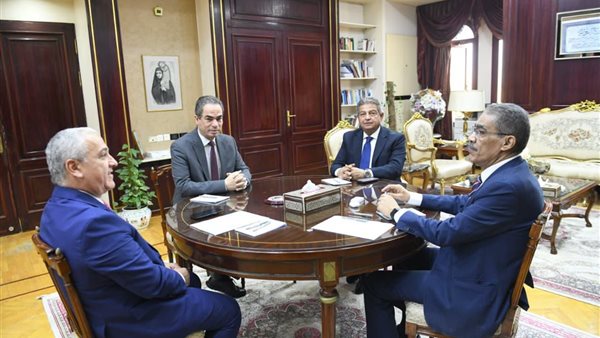
Holding journalist writer Diaa Rashwan Minister of State for Information Today, Tuesday, a meeting was held that included: journalist Diaa Rashwan, Minister of State for Information, and engineer Khaled Abdel Aziz, Chairman of the Supreme Council for Media Regulation. Engineer Abdel Sadiq Al-Shorbaji, Chairman of the National Press Authority. And Ahmed Al-Maslamani, Chairman of the National Media Authority, in implementation of the assignments of President Abdel Fattah El-Sisi, President of the Republic, to the Ministry of State for Information.
A meeting between the Minister of State for Information and heads of media organizations
The meeting was held in the office of the Minister of State for Information, and the meeting participants agreed on the following:
First: Thanking President Abdel Fattah El-Sisi for what was included in his document of assignments to the newly formed government, especially Clause No. (8) in these assignments, which stipulates “giving the utmost importance to public opinion and its continuous insight into the facts through a national media capable of reaching all components of Egyptian society and presenting to it a professional, responsible discourse that forms collective awareness in the face of the challenges we face and the spread of rumors, and enhances the culture of constructive dialogue and the development of the ability to think soundly and respect the opinions of others.” The participants in the meeting stressed that these assignments are a work program that each must strive to achieve in his field of expertise.
Second: The participants expressed their appreciation to Dr. Mostafa Madbouly, Prime Minister, for his great interest in the Egyptian media, achieving his tasks in consolidating Egyptian identity and enlightened culture, and highlighting challenges and problems to decision-makers objectively.
The participants in the meeting also praised the president’s directives during his meeting with journalist Diaa Rashwan, Minister of State for Information, yesterday, Monday, February 16, 2026, especially his emphasis on “the necessity of working on continuous coordination with the competent media bodies, in a way that ensures the achievement of integration and coherence between the ministry and these bodies, and in a way that preserves at the same time the independence of those bodies, which is guaranteed by the Constitution in clear texts, and in a way that provides a common ground for the arena of discussion for various national issues, all in order to restore the status of the Egyptian media in all its aspects.” Achieving qualitative breakthroughs in the message of the national media that is capable of addressing citizens with simple and powerful messages that include lofty goals that take into account the values, traditions and ideals of Egyptian society without excluding any faction in society, while always adhering to the freedom of expression and opinion guaranteed by the Constitution and the law, taking into account adherence to the standards of objectivity and impartiality and not compromising the values and principles of society.”
Third: The heads of the Supreme Council for Media Regulation, the National Press Authority, and the National Media Authority congratulated the journalist Diaa Rashwan on his assumption of the position of Minister of State for Information, and expressed their confidence that the multiple experiences he possesses in the fields of media of all kinds, and political work, and the trust and appreciation he has from workers in the fields of Egyptian media in all their categories, are sufficient to achieve success for this ministry to carry out what the state, the media community, and society hope for in terms of the role of the Ministry of State for Information at this stage. Current.
Fourth: The participants in the meeting expressed their sincere desire for joint cooperation, within a framework of integration of roles, with full awareness of the role of the Ministry of State for Information in accordance with the assignments entrusted to it by the President of the Republic, and what was included in the directives of Dr. the Prime Minister, which are summarized in: activating the articles of the Constitution and laws regarding the press and media, freedom of opinion and expression, and the associated commitment to professionalism and the sanctity of private life, and representing the government before public opinion, whether by presenting the truth of the policies and procedures it is implementing in its favor or by correcting any fallacies that may occur. regarding it, and coordination between the various media bodies and entities with regard to Egyptian media affairs, and respecting the roles of the three media bodies in accordance with what is stated regarding them in the articles of the constitution, especially Articles Nos. (211) – (212) – (213), in addition to the laws related to these bodies: Law No. (180) of 2018 regarding the Supreme Council for Media Regulation, and what it contains regarding the powers of the Council in particular: receiving notifications to establish newspapers, and granting licenses to practice media activity for audio and visual media. And digital, and to establish and implement the necessary controls and standards to ensure that media and journalistic institutions adhere to the principles and ethics of the profession, and Law No. (179) of 2018 regarding the National Press Authority, and what it included regarding the authority’s powers, especially “managing press institutions that are privately owned by the state and working to develop them, grow their assets, and ensure their modernization, independence, impartiality, and commitment to sound professional, administrative, and economic performance,” and Law No. (178) of 2018 regarding the National Authority. For the media, and what it includes regarding the Authority’s powers, in particular: “Management of public media institutions to provide broadcasting, television, radio and digital production services and related engineering services.”
Fifth: The participants in the meeting affirmed their firm determination to cooperate seriously and continuously to achieve what the state and society aspire to regarding improving media work and the media message, developing professional performance and supporting the role of media institutions to carry out their tasks, in a way that keeps pace with the new phase of the state’s plans in the field of comprehensive development and improving public performance in all areas of national work. Sixth: In conclusion, the participants affirmed their keenness to continue meetings with each other periodically to enhance the integration of roles in the field of institutional performance for each of them.