


Monday 09 March 2026 – 11:29 AM
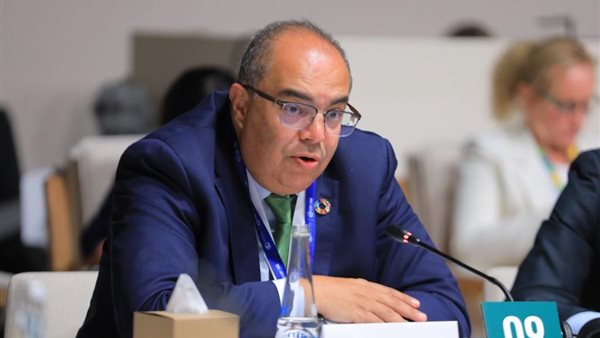
Dr. Mahmoud Mohieldin, the United Nations Secretary-General’s Envoy for Sustainable Development, and Chairman of the United Nations Committee of Experts to Provide Solutions to the International Debt Crisis, confirmed that the world has entered a phase of new confusions and successive crises that force officials and decision-makers to adopt an approach of permanent preparedness instead of reaction.
In his speech during a discussion session on global economic conditions and their local impacts organized by De Code and in the presence of the Ministers of Finance, Investment, Foreign Trade, Planning, Economic Development and Industry, he pointed out that the major transformations in artificial intelligence and regional geopolitical tensions impose a new economic and social reality that requires superior institutional flexibility.
Dr. Mahmoud Mohieddin emphasized that in the relationship between man and machine: artificial intelligence is an inevitable fate, and its advantages are higher than its risks for those who make good use of the technological revolution, as artificial intelligence reformulates the relationship between man and machine. He added:
Mohieddin said: Any attempt to stop technological development or become closed to artificial intelligence will inevitably lead to falling behind the global curve. History has taught us that wrong decisions to close down, as happened in some historical experiments, have effects extending for decades.
Quality of technological services and scientific research
Mohieddin revealed a radical shift in the labor market, noting that according to some recently issued reports, coding, which was seen as a promising field for humans, is now being accomplished by artificial intelligence 90% of its tasks, stressing that real investment must be focused on the quality of technological services, scientific research, and qualifying the human element to deal with these developments.
He touched on the concept of new regionalism, expressing his regret that the Middle East region is still suffering from turmoil that hinders joint cooperation, stressing that the security and stability of any country in the region is organically linked to the stability of its neighbors, saying: “The development situation in our Arab countries will not be stabilized unless it is stabilized in our Arab regional environment without any exception, and that Arab harm is harm to all Arabs, even if some do not think otherwise,” and that the narrow view of some people that the misfortunes of a people have benefits that can be exploited ignores the fact that we are one people. Either we evolve together or we all deteriorate.
Muhyiddin called for inspiration from the ASEAN model in Southeast Asia, which succeeded in creating economic cooperation spaces despite the challenges, warning that the continuation of conflicts in the region entering their second week and the repercussions that follow will not be closed easily, and will have a direct impact on the paths of life, development and the economy.
Major logistics and commodity product sectors
In his analysis of the current crisis, Mohieddin explained that the Gulf economy represents a fundamental pillar in the global economy, not only due to its relative weight in the gross domestic product, but also due to its deep integration into global supply chains, logistics sectors, and major commodity products, as well as its vital energy impact.
He pointed out that the turmoil in global markets and the hot flight of capital are a natural result of the state of war and uncertainty, stressing that the lesson lies in the period of war and the changes that will result from it.
Speaking about the situation in Egypt, Mohieldin expected a review of economic growth rates if the war lasted, noting that vital sectors would be affected, in addition to the inflationary pressures resulting from global energy prices.
Regarding economic management, he stressed several points, including policy coordination, as he emphasized that managing the economy is not “deals and snapshots,” but rather the product of policies and institutions, stressing the importance of continuing to work in the spirit of a single economic team that is harmonious in its performance, especially with the experience and excellence of its members.
Changing the perception of humans as mere population numbers
Speaking about investment, Mohieddin explained that investment is a collective responsibility. Without the support of public financial and monetary policies and the openness of all economic sectors, investment promotion plans will fail to reach their goals, emphasizing the country’s achievements in terms of establishing security and developing infrastructure.
Dr. Mahmoud Mohieldin concluded his speech by emphasizing that the strength of any country is measured by the strength of its weakest link, and that preparing for risks to avoid their consequences if we do not prepare for them is the only way to survive in a world of “permanent confusions.”
Regarding human wealth in Egypt, he called for changing the perception of humans as mere numbers in the population census. Humans are the possessors of thought and the driving force for growth, and are not just consumer numbers. Their role is inevitable to benefit from technological developments and artificial intelligence, especially with the young demographic composition in Egypt.
He pointed out that the decline in the population growth rate gives an indication of changing patterns of economic activity and demand in the future, which requires exploiting “human capital” through education, health, training, and digital transformation.