

Saturday 07/March/2026 – 08:56 PM
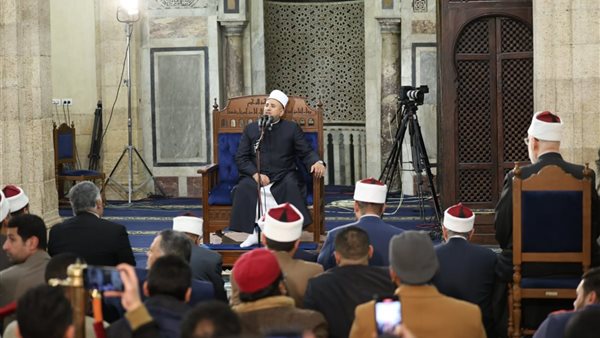
Dr. Ahmed Ali Hammam, Director General of the Affairs of the Council of Senior Scholars, delivered an awareness lesson during Tarawih prayers at Al-Azhar Mosque, under the title “Ethics of War in Islam,” in the presence of His Eminence Professor Dr. Muhammad Al-Duwaini, Undersecretary of Al-Azhar, and a group of Al-Azhar’s scholars and Egyptian worshipers, students, and expatriates. The lesson focused on the Qur’anic principles and the Prophet’s biography that determine moral behavior in war, and clarify human rights even in times of conflict.
Dr. Hammam pointed out that Islam set clear rules for war, including not attacking innocent people, protecting women and children, and preserving property and land, stressing that war in Islam aims to repel aggression and achieve justice, and is not a means of injustice or destruction.
Dr. Hammam also explained that the Holy Qur’an and the Sunnah of the Prophet defined the rights of combatants and non-combatants, as God Almighty said: “And fight in the cause of God those who fight you, but do not aggress. Indeed, God does not like aggressors,” adding that the Prophet Muhammad, peace and blessings of God be upon him, advised the army commanders not to Killing boys, women, or peaceful people, not destroying homes or lands, and following the noble morals of war in all battles.
An educational lesson for Al-Azhar Al-Sharif during Tarawih prayer
Dr. Ahmed Ali Hammam pointed out in the lesson that some of the aggressor powers, including the occupation, are pursuing destructive policies of violence and war that do not take into account the rights of children and women, and do not respect homes or holy places, but rather adopt what is known as a “scorched earth policy,” which aims to comprehensively destroy infrastructure and annihilate communities, contrary to the moral rules of war that Islam brought about, which protect civilians, prohibit attacks on innocents, and emphasize justice and mercy even in times of conflict.
The lesson concluded by emphasizing that the ethics of war in Islam reflect the values of mercy, justice, and humanity, and that these principles must be a permanent model in the behavior of Muslims, reflecting the mission of Al-Azhar Al-Sharif in spreading religious and moral awareness during the blessed month of Ramadan.
Al-Azhar Al-Sharif continues to fulfill its mission during the holy month through an integrated program that includes holding Tarawih prayers daily at 20 rak’ahs with the ten recitations, and Tahajjud prayer in the last ten rak’ahs at the rate of eight rak’ahs every night, organizing 137 lessons and lectures with the participation of senior scholars, holding 130 Qur’anic recitations daily, in addition to organizing the zakat and charity house and breakfast and suhoor tables for foreign students, with a total of 300,000 meals throughout the month, within the framework of Its religious, advocacy and social role and the promotion of the values of solidarity, compassion and charity in society.