


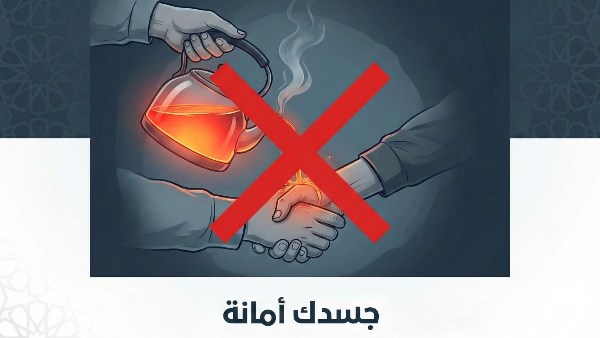
Dar followed Fatwa Al-Masryah: Dangerous clips and actions have been circulating recently on some social media platforms, showing some people holding two people by the hand, and then a third person pouring a cup of boiling tea on them, claiming to measure their endurance or test the extent of the bond and relationship between them, and claiming that one of them withdrawing his hand quickly is evidence of the weakness of the relationship, while withstanding the heat is proof of the strength of friendship.
The Egyptian Fatwa House confirms that this behavior is considered a forbidden act according to Islamic law. Because it entails intentional harm to the human soul and exposing it to danger without any valid justification, which is clearly inconsistent with the teachings of Islamic law and its overall objectives.
The house explains that preserving oneself is one of the greatest goals of Islamic law, and all divine laws have agreed upon it, and it has been elevated in Islam from a mere human right to a necessary legal duty. Sharia law did not limit itself to establishing the right to life and bodily integrity, but it also obligated a person to take everything that would preserve his body and protect it from damage and harm.
Among the manifestations of Islam’s care for the human soul are the following:
• The prohibition of killing oneself unlawfully. God Almighty said: “And do not kill the soul that God has made unlawful except in a just manner.” [الأنعام: 151].
• Prohibiting suicide and exposing oneself to destruction. The Almighty said: “And do not kill yourselves. Indeed, Allah is ever Merciful to you.” [النساء: 29].
• The explicit prohibition of throwing oneself into destruction. God Almighty said: “And do not throw oneself into destruction with your own hands.” [البقرة: 195].
• The Prophet, peace and blessings of God be upon him, also established a comprehensive rule of Sharia law by saying: “Neither harm nor harm,” which is a rule that regulates a Muslim’s behavior in his relationship with himself and others, and prevents everything that leads to harm or harm.
Based on this, the Egyptian Fatwa House stresses that testing friendship or interdependence by harming bodies and submitting to harmful or superstitious practices is something that is rejected by law and reason, and has nothing to do with human values or Islamic teachings. Rather, it opens the door to disdain for physical safety and encourages the imitation of dangerous behaviors that may lead to serious injuries.
The Egyptian Fatwa House calls on our honorable youth to be aware and responsible, to stay away from the superstitions and absurd challenges spread through social networking sites, and to return to the people of knowledge and expertise in matters of religion that are problematic, in order to preserve the human soul and preserve the dignity with which God has honored man.
May God protect our youth from all evil, guide them to all goodness, and make them an asset to our dear homeland.