

Reports and investigations
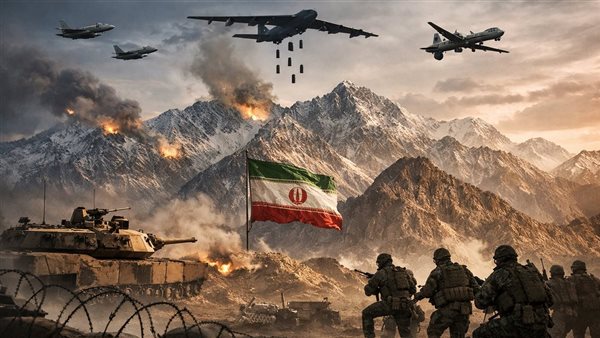
Internal war in Iran_image created by artificial intelligence
Monday 09 March 2026 – 03:55 PM
Major wars are not decided from the air. This is a military rule that has been reported and confirmed by many military reports and analyzes over the past decades and years, stressing that to overthrow a regime or eliminate an army requires a ground presence (in any form), but implementing the American military invasion in its traditional form, as happened in Iraq, on Iranian territory represents military and logistical suicide whose human and financial costs Washington cannot bear.
Iran will not fall with enemy armies
As soon as we look at the Iranian topographical map, it will become clear to everyone that the Iranian mountains are the first impenetrable wall against any ground invasion of Iran from the outside, which makes it difficult for America to repeat the scenario of neighboring Iraq in Persia to overthrow the Velayat-e Faqih regime militarily from abroad. But (and this is also important) by returning to the history of the United States of America, which is stained with the blood of many regimes, an example emerges from the neighbor as well, but it is somewhat far from the border, and by that I mean America’s overthrow of the Taliban’s rule in Afghanistan in 2017. 2001 at the hands of the Afghan opposition from within, by arming them and supporting them intelligence, logistically and politically from the outside as well by providing them with international cover.

How does Iran fall?
But how can this be applied in Iran, which is under the mantle of the upcoming son-in-law (Mojtaba Khamenei), carrying hopes of revenge for his son, father, mother, and sister, and for his country as well, and surrounded by a missile and human arsenal represented by the Revolutionary Guard, the Basij forces, and the regular army, in addition to its foreign arms?
To understand this, we must look at the demographic composition of Iran. Every force has a weak point to topple it, and Iran’s Velayat-e Faqih is known for its demographic composition as its strongest military and political vulnerability. Washington can create an internal army through the Iranian minorities, and strengthen them militarily and logistically, leading to the overthrow of the regime internally at the hands of his own people. Killing the Supreme Leader did not and will not bring down the regime, but the regime will fall by destroying its institutions upon which it is based, most notably the Revolutionary Guard forces, the Basij, and the army. Iranian regular.
The Kurds are an enemy waiting for a signal
If we look at the human composition of Iran, we see many minorities that America is believed to resort to to overthrow the regime, the most prominent and important of which are the Kurds located on the northwestern borders of the country, adjacent to both Turkey and Iraq, as intelligence reports since the beginning of the war indicated the presence of unusual Kurdish movements by Kurdish opposition factions in Iran, near the border with the Iraqi Kurdistan region in preparation for an expected ground incursion, or in preparation for activating what can be described as Kurdish sleeper cells. In western Iranian cities such as Sandang and Mahabad.
These movements were followed by qualitative military flows represented by medium weapons and drones, which can be used as spearheads to exhaust the Iranian Revolutionary Guard forces from the western gate, and drag them into extended guerrilla wars in the rugged Zagros Mountains (the Zagros Mountains are the most important natural fortress that Iran has for its protectors from the western side, as they cannot be invaded by conventional armies from the west due to the difficult terrain of the Zagros Mountains on the Turkish and Iraqi borders as well).

Ahwazi Arabs waiting for independence
Moving to the south, we reach the Ahwaz region (the soft flank of the leader’s cloak), where Iran’s oil strike force is located. More than 80% of Iran’s oil reserves and most of the gas fields are located in the region. However, the Arab majority in the region, which has often called for secession from Iran, does not feel any prosperity in its land, as reports indicate that the region’s citizens have been living for decades in the absence of political repression and deliberate economic impoverishment from Tehran.
In the plan to overthrow the regime, the military reliance on Ahwaz will not be as great as the reliance on directing strikes on oil refineries and disrupting them will be much more important. Therefore, to confuse the financial portfolio on which the Supreme Leader’s regime depends, by launching strikes planned by American intelligence and carried out by the hands of the Iranians themselves, which will accelerate Tehran’s economic collapse.
Internal division at the hands of the cousins
Looking to the north, we will find the Azerbaijani giant (I do not mean Azerbaijan, the state, but the Azerbaijani minority in northern Iran, who are the largest ethnic minority in Iran) stationed in the northern provinces. Their danger, if America wants to use them, lies in the fact that they are present in large numbers in the cabinets of the Iranian state, to the point that many of them joined the Iranian Revolutionary Guard years ago, which represents the striking forces to protect the Supreme Leader’s regime.
America can offer them political temptations after the national conflicts between the Persians and the Azeris increased, which means that their decision to join a confrontation with the regime in Tehran will mean an accelerated collapse of their ability to obtain huge military and intelligence support through Azerbaijan, Israel’s most prominent ally on the borders of Iran, as this does not represent a mere peripheral rebellion, but rather a rift that reaches the point of internal division in the Supreme Leader’s regime.

A thorn in the side of the Revolutionary Guards
By completing the circle around Tehran and heading east, America will see the Balochistan region, which has been suffering from political and economic marginalization for religious reasons for decades, causing frequent conflicts between what is known as the Army of Justice (separatist forces inside the region) and the Iranian Revolutionary Guard. However, the American entry will mean more weapons, intelligence support, and marches that can be used in the Lut and Kawir deserts (the largest deserts in Iran and used by Tehran as an eastern shield, as the Army cannot… My regime crossing those harsh, difficult-to-monitor mountainous deserts with Afghanistan and Pakistan) to exhaust the Revolutionary Guard and drag thousands of its soldiers into endless confrontations that would weaken the Guard in conjunction with the rest of the other fronts mentioned above.
America’s decision spells the end
If America uses the four fronts simultaneously, this will lead to a state of military and economic paralysis and dispersion among the joints of Iranian rule, bringing the government to the stage of internal collapse, which would cause a loud earthquake in the Middle East and not just within Iran’s borders. The fall of Tehran or its entry into a civil war would be followed by the collapse of Iran’s arms abroad, and it could also be followed by the geographical division of Iran, which is a scenario that Israel has often sought, and America has not shown enthusiasm about.

Iran does not fall easily
By entering into the closet of the Iranian regime itself, it cannot be considered an easy prey on any of the four internal fronts, as well as externally. The Tehran regime can withstand militarily and politically, as it has experience extending for several decades in facing internal repercussions and confrontations, and has the historical ability to crush any internal efforts for secession, represented by the Revolutionary Guards.
This confirms that the destruction of Iran is difficult to achieve by the hands of America and Israel alone. If America seeks to do so, the internal gateway through proxy wars and their military, intelligence and logistical fueling will be the straw that breaks the back of the Guardianship of the Jurist.