
Thursday 12/March/2026 – 01:32 AM
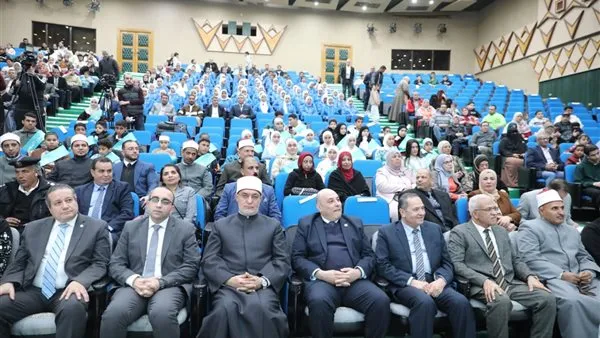
Dr. Nazir Muhammad Ayyad, Mufti of the Republic, Head of the General Secretariat of Fatwa Houses and Bodies in the World, witnessed the ceremony honoring the winners of the Holy Quran memorizers in the competition that was launched under the auspices of the Governor of Ismailia, and implemented by the Jusoor Initiative under the title: “Bridges of Love” in coordination with Al-Azhar Al-Sharif and the Ministry of Education.
Mufti: I call on my students to continue memorizing the Qur’an
In his speech during the honoring ceremony, His Eminence the Mufti of the Republic affirmed that this meeting is one of the important meetings that he looks forward to attending every year, as everyone gathers for a banquet of the Holy Qur’an, especially in the blessed month of Ramadan, the month of the Holy Qur’an, and with our children, whom we should look at with more care, attention and a lot of attention, as they are based on the Book of God Almighty to preserve, learn and ponder, pointing out that all the contestants in this competition have won both divine and moral honor, in credence. According to the saying of the Prophet, may God’s prayers and peace be upon him and his family: “The best of you is the one who learns and teaches the Qur’an.
The Mufti added: We are facing a unique event and a great celebration related to contestants competing in memorizing, contemplating and reciting the Book of God Almighty. Everyone is honored by God, Blessed and Most High, as the Prophet, may God bless him and grant him peace, says: “It is said to the reciter of the Qur’an, ‘Read, recite, and ascend.’ Likewise, worldly honors are given in such celebrations, and what we see of this presence, which came to participate and support those who have memorized the Book of God Almighty, is sufficient.
His Eminence added: We should begin the discussion about the Holy Qur’an by recalling its comprehensive status, as the origin of spiritual identity, the reference for intellectual unity, and the basis of religious stability on which the Islamic state, ancient and modern, has been established over the centuries. The Holy Qur’an was – and still is – the center of rational religiosity, the control of sound understanding, and the source of moderation that protected society from extremism and negligence, and linked the authenticity of the text to the realism of the revelation.
His Eminence the Mufti of the Republic pointed out that talking about the Holy Qur’an and what is related to it, in this context, is an affirmation of the civilizational role of the dear book in establishing spiritual security, building humanity, and directing legitimate policy in a way that combines loyalty to the principles of revelation and good care for the interests of the people, under a leadership that made serving and protecting the Qur’an an honor, and preserving the religion and preserving its purposes an inherited historical trust, adding that since this lofty status of the Holy Qur’an was the foundation on which the features of religiosity were built Al-Rashid, and in its shadow the balance of moderation and uprightness was set. Moving to clarifying the truth of this dear book requires emphasizing that talking about it is not reduced to being a text, or a heritage preserved in the chests and lines, but rather it is talking about the source of the spiritual and intellectual life of the nation, and about the revelation that shaped the conscience of the Muslim person, guided his mind, built his civilization, and taught him how to balance the demands of faith and the necessities of urbanization.
The Mufti pointed out that this participation is a great opportunity to talk about the Holy Qur’an in a time when there is a growing need to reconnect consciously with the Book of God Almighty, not at the level of recitation alone, but at the level of understanding and contemplation, and invoking Quranic guidance in people’s reality, legislation, and behavior. Knowing the characteristics of the Holy Qur’an, understanding its authority, and understanding its approach to rulings, represents a necessary entrance to building rational jurisprudence, balanced thought, and responsible religious discourse that preserves the sanctity of the rulings, highlights their wisdom, and improves their revelation in a changing reality, without violating the constants of revelation or its higher purposes.
His Eminence the Mufti concluded that the Qur’anic word is chosen with a precise balance, and every sentence in it is placed in a place that no other can do better, and every verse comes in proportion to the meaning it carries, neither adding to it as it becomes burdensome, nor decreasing as it becomes distorted, thus achieving the systems a perfection that human explanation cannot achieve, no matter how great it is, which motivates us to make efforts in memorizing the Holy Qur’an and learning about its provisions and secrets, stressing that humanity is now in dire need to return to its senses and correctness, and this will not be achieved except by returning to the book. Its Lord, in confirmation of the Almighty’s saying (a book which We have sent down to you that you may bring people out of darkness into light, by the permission of their Lord, to the path of the Mighty, the Praiseworthy) is a book that God, Blessed and Most High, revealed to be a reason In bringing people out of the narrowness of this world to the spaciousness of the afterlife.
His Eminence the Mufti gave his male and female students a number of pieces of advice urging them to be confident and responsible, and to continue memorizing the Book of God, working on it, and competing in it, and in this, let the competitors compete.