

Monday 30 March 2026 – 07:35 PM
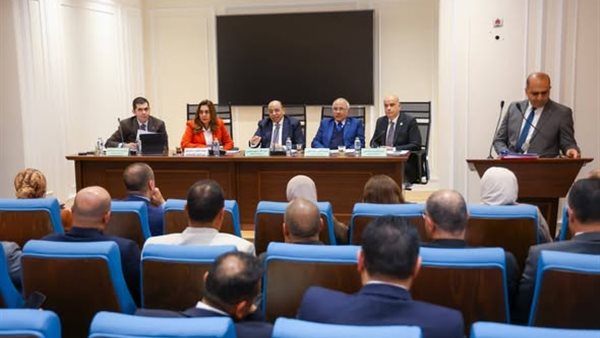
Dr. Manal Awad, Minister of Local Development and Environment, met with members of the Local Administration Committee of the House of Representatives, headed by Representative Major General Mahmoud Shaarawy, at the House of Representatives headquarters in the New Capital, to review the Ministry’s vision and efforts in the integrated waste management system, respond to a number of briefing requests submitted by representatives, and listen to all the observations and challenges raised on the ground, within the framework of emphasizing the government’s approach to enhancing transparency and direct interaction with representatives of the people, and ensuring a rapid response to citizens’ complaints and demands in various files. SOA.
Environment: A plan to close 7 random dumps…and 69 million pounds in economic returns from poultry and fish waste
During the meeting, Dr. Manal Awad reviewed the efforts made to develop the integrated waste management system in the governorates, stressing that the state has made great strides in implementing the infrastructure of the municipal waste system, as 45 sanitary landfills, 19 fixed intermediate stations, and 14 mobile stations have been implemented, in addition to establishing 4 recycling factories, rehabilitating 10 treatment lines, and implementing 4 primary sorting lines at the level of the governorates of the Republic.
Dr. Manal Awad explained that with regard to closing random dumps, the Ministry has implemented an integrated plan in cooperation with the concerned authorities to close and rehabilitate 7 sites, pointing out that an integrated plan is being implemented to close the transit dump, as part of the state’s efforts to eliminate random dumps, stressing that receiving waste will be stopped as of next April, with its transfer to the sanitary landfill in the Integrated Waste Management City on the 10th of Ramadan. The necessary measures have also been taken to address the competent authorities, in preparation for the start of the closure work through the company. Implemented.
The Minister of Local Development and Environment also indicated that with regard to the rest of the random dump sites, the state continues to implement an integrated plan for closure and rehabilitation according to specific timetables, as the closure of the Al-Salam landfill has been completed through the New Urban Communities Authority in implementation of the directives of the Prime Minister, while the Qalabsho landfill in Dakahlia Governorate is currently being closed as part of the Kitchener Bank disinfection project, in addition to implementing a phased plan to close the Abu Zaabal landfill with support from the World Bank project, and work is also underway to rehabilitate the cells of the Sadat sanitary landfill through… The National Solid Waste Programme, and the private sector will be contracted to carry out the rehabilitation and closure of the Shabramant dumpsite. Abu Greda dumpsite is also being rehabilitated in Damietta Governorate to organize operation work through the company responsible for treatment and final disposal, within the framework of a comprehensive vision aimed at eliminating random dumps and transforming them into environmentally safe sites, which contributes to improving the quality of the environment and public health and opening new horizons for investment in this vital sector.
Dr. Manal Awad added that the project to establish an integrated waste management complex in Tenth of Ramadan City is one of the major national projects, as it is being built on an area of 1,228 acres to serve the governorates of Cairo and Qalyubia, and infrastructure work is currently being implemented in it, in parallel with the preparation of tender documents for the private sector, noting that to ensure the correct operation of the infrastructure and to benefit from it in the optimal way, a model of conditions and specifications for collection and transportation services, street cleaning, and the operation of fixed intermediate stations and treatment plants has been prepared. And landfills, where 23 contracts were contracted to collect and transport waste in major governorates, in addition to the involvement of about 500 small and medium-sized companies and civil society organizations, in addition to implementing 27 contracts for treatment services in 21 governorates, and 2 in new cities in the East and West Nile sectors, where 6 cement companies were involved to invest in treating waste to increase the amount of alternative fuel (RDF) produced, in a way that enhances the role of the private sector and achieves operational efficiency.
The Minister of Local Development and Environment confirmed that the performance indicators witnessed a noticeable improvement, as the collection efficiency reached 80%, and the recycling rate reached 50%, while the amount of alternative fuel RDF produced reached 1.9 million tons annually. With regard to agricultural waste, she explained that efforts to confront the black cloud witnessed a significant development, as the number of rice straw collection sites increased to 655 sites in 2025, with total quantities reaching 2.6 million tons, with a noticeable decrease in the number of open burning reports, reflecting the success of The system.
The Minister of Local Development and Environment also reviewed the Ministry’s efforts to support bioenergy projects, as 1,931 home biogas units were implemented in 19 governorates, with a total amount of biogas produced from these units of 2.1 million cubic meters annually, equivalent to 70,000 butane cylinders, and it treats animal waste amounting to 53,000 tons annually, which contributes to improving the standard of living of citizens and reducing emissions.
Regarding the poultry and fish waste system, Dr. Manal Awad indicated that requirements have been set for the process of collecting and transporting these wastes, as licenses were granted to 34 specialized companies, within the framework of maximizing the economic benefit from the waste, as financial revenues were achieved for the governorates amounting to about 69 million pounds annually.
The Minister of Local Development and Environment also addressed efforts to regulate demolition and construction waste, as technical requirements were prepared in cooperation with the National Building Materials Research Center and were sent for circulation to the governorates, and treatment sites were identified in 21 governorates. A guide was also issued to estimate quantities and costs, in a way that supports investment plans in this sector. With regard to medical waste, Dr. Manal Awad explained that an integrated guide was prepared, including all stages of handling and integrated management of medical waste, and a training guide was prepared for the system that includes all its employees, in addition to Inventorying and evaluating treatment facilities nationwide, in preparation for offering treatment services to the private sector according to an integrated vision.
The Minister of Local Development and Environment reviewed the efforts made in the field of electronic waste, noting that the conditions of 38 recycling factories and 5 cable factories had been legalized, in addition to benefiting from a World Bank grant worth $9.130 million to support the management of this type of waste.
In the context of tightening control over the used edible oil system and maximizing its benefit, the Minister of Local Development and Environment explained that the Ministry took a number of decisive regulatory measures, following the issuance of the Ministry’s Resolution No. 150 of 2025, where 7 licenses were issued to collect, transport and store used edible oils to companies that registered on the Wims website, and 9 export permits were issued to a number of companies working in this field, ensuring the integration of the informal sector into the official system, enhancing the efficiency of tracking and control, and establishing An integrated framework for organizing the collection, transportation, storage, and export of oils, through the preparation of a guidebook that clarifies the mechanisms for carrying out the activity, and defining the requirements and standards necessary for obtaining licenses and permits. Work has also been done to prepare specifications for bidding in the governorates, with the aim of increasing the quantities of collected oils and linking them to investment projects, in a way that contributes to achieving an economic return and transforming this type of waste into a value-added resource within the framework of the circular economy.
At the conclusion of the meeting, Dr. Manal Awad confirmed that the waste management file is no longer just an environmental challenge, but has become a promising investment opportunity that contributes to creating job opportunities, stressing continued coordination with all concerned parties to achieve a qualitative shift in this sector.
During the meeting, the Minister of Local Development and Environment listened to the presentation of the Chairman of the Committee and a number of members of some vital files that directly affect the quality of life of citizens, where there was an extensive discussion about the integrated waste management system, and the tangible progress achieved in it at the level of infrastructure and operation, in addition to a review of the existing challenges and mechanisms for dealing with them in a way that ensures improving the quality of life for citizens.
The Minister of Local Development and Environment, Head of the Waste Management Regulatory Authority, directed the need to follow up on solving the problems of waste and garbage accumulation in the city of Mahalla al-Kubra in Gharbia, and to send an urgent committee to follow up on the solid waste system in the governorate and support the governorate’s efforts to develop a booklet of conditions and specifications for contracting with private sector companies working in the field of residential collection and waste transportation in neighborhoods to provide opportunities in the system for those companies.
Dr. Manal Awad also directed the development of an action plan for district heads in the governorate that takes into account the technical and environmental requirements regarding specifications and making it available to private sector companies wishing to enter the solid waste system.