
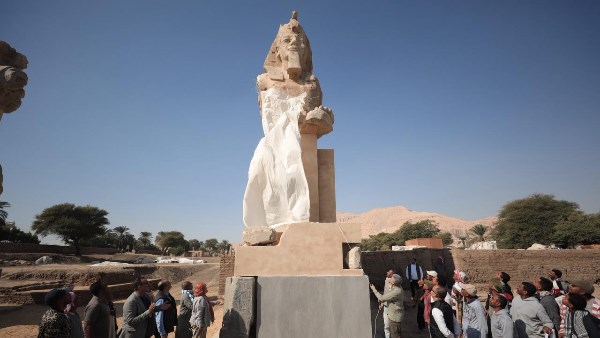
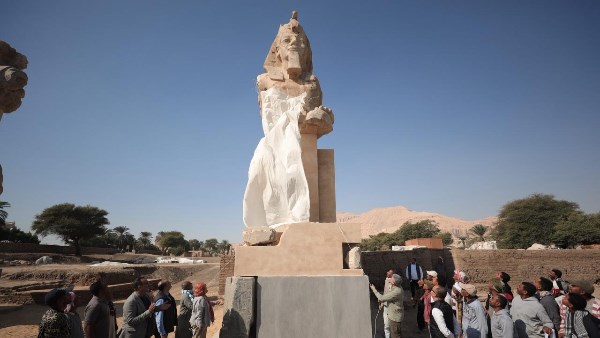
The past few hours witnessed the unveiling of two huge alabaster statues of King Amenhotep III, after they were restored, re-installed and raised to their original location in the third edifice of the king’s funerary temple on the western side of Luxor. Within this framework, the Supreme Council of Antiquities shed light on the project to preserve the statues of Memnon and the temple of King Amenhotep III.
The Colossi of Memnon and the Temple of Amenhotep III
“Sada El Balad” monitors the 15 most important pieces of information about the Memnon Colossi project and the Temple of Amenhotep III
1- Restoration, re-installation and raising of a pair of seated statues made of quartzite
2- Raising two standing royal statues made of quartzite at the northern gate of the temple sanctuary
3-These dismantled antiquities were rescued and removed from the silt and salt water
4-Returning them to their original locations by lowering the groundwater level
5- Helps lower the ground level by about three metres
6-280 statues and parts of statues of the goddess Sekhmet were found
7-The statues are currently waiting to be displayed in the temple’s hypostyle courtyard
8- The discovery and rescue of two limestone Sphinx statues
9-The funerary temple of Amenhotep III was built in the first half of the 14th century BC over the 39 years of his reign.
10- The temple is considered the largest and richest among the funerary temples
11- The temple collapsed as a result of an earthquake in 1200 BC
12- Its remains were used as a quarry in later eras, before it was affected by floods
13-Only the two statues of Memnon remain of the temple’s features
14- The rest of the ruins were destroyed and drowned in salt water.
15-In the 19th century, antiquities collectors seized pieces of its ruins