
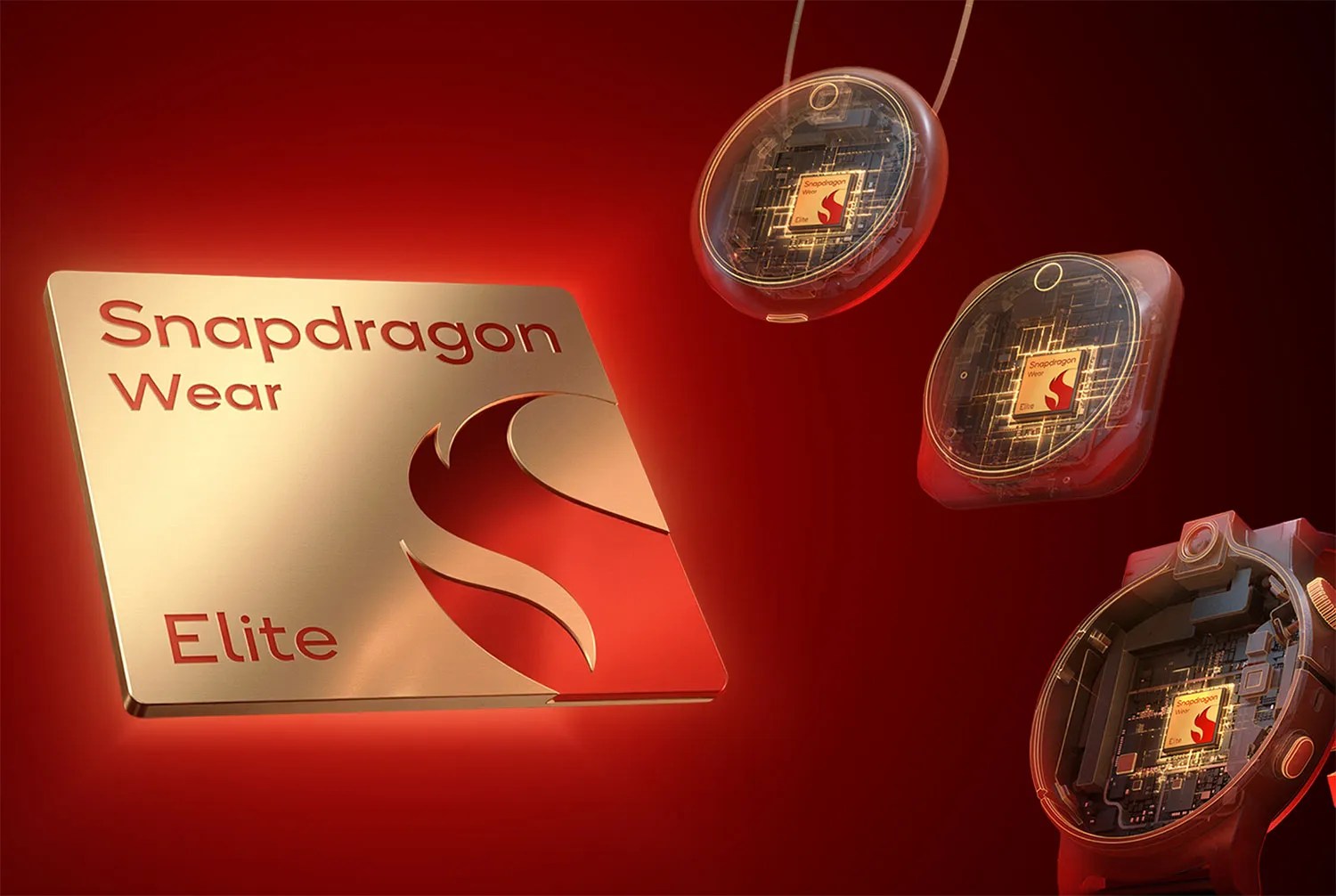
During its participation in the MWC 2026 conference in Barcelona, Qualcomm revealed the Snapdragon Wear Elite platform, which is the most powerful processor for wearable devices launched by the company so far, and the first platform in this sector to bear the “Elite” brand.
With this platform, Qualcomm aims to enable a new generation of personal artificial intelligence devices, not limited to smart watches only, but also including pins and devices worn on the body that act as independent artificial intelligence units, instead of being mere phone accessories.
The platform integrates for the first time a dedicated Hexagon NPU within a wearable-oriented chip, with support for running AI models of up to two billion parameters directly on the device.
In addition, the platform relies on a dual architecture of neural processing units, where a low-consumption unit handles permanent tasks such as word and activity recognition, while the Hexagon unit handles more complex tasks such as small language models, computer vision, and intelligent agents.
The chip is based on a five-core central processor with a frequency of up to 2.1 GHz, along with an Adreno A622 graphics processor that supports Vulkan 1.2 and OpenGL ES 3.2.
According to Qualcomm, the platform achieves five times faster performance at the single-core level, and seven times faster performance in graphics compared to the previous generation Snapdragon W5+ Gen 2, which is reflected in greater smoothness in running applications and multitasking.

In terms of energy, the platform provides 30% longer battery life compared to the previous generation, while supporting fast charging of up to 50% within about 10 minutes, according to the company’s internal tests.
In terms of connectivity, the platform integrates six wireless technologies, including 5G RedCap, low-consumption Wi-Fi 6, Bluetooth 6, Ultra-Wideband, and dual-frequency GNSS, in addition to supporting NB-NTN satellite communication to send and receive messages in the absence of traditional networks.
The platform supports Wear OS, Android, and Linux, and Qualcomm has confirmed support for partners such as Google, Motorola, and Samsung, with the first commercial devices expected to be launched in the coming months, including the next generation Galaxy Watch.
With this move, Qualcomm is promoting the transformation of wearable devices into independent artificial intelligence platforms capable of sensing, processing and decision-making locally, without complete dependence on the phone.