
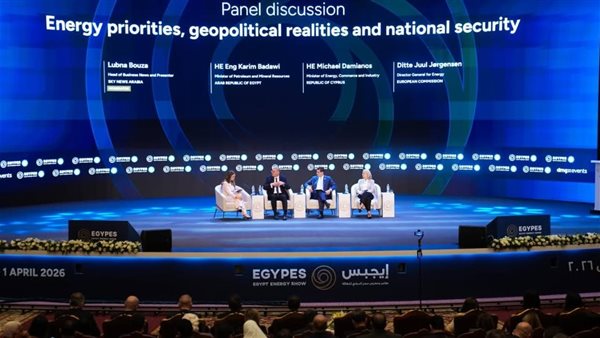
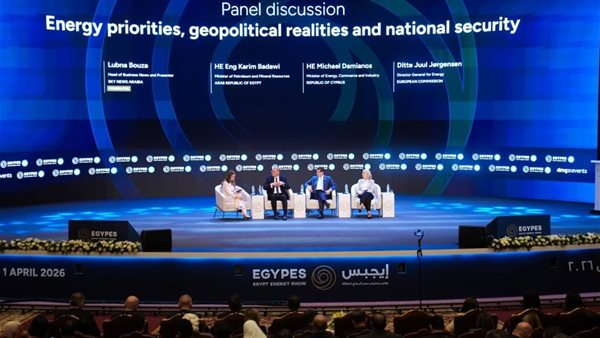
At the heart of the activities of the Egypt International Energy Conference and Exhibition “EGYPS 2026”, energy ministers sat around one table, but the discussion this time was not traditional, but rather revolved around one question: How can energy be secured in a world where crises are accelerating?
Amid this scene, Engineer Karim Badawi, Minister of Petroleum and Mineral Resources, confirmed that the priority in Egypt is clear and cannot be postponed: securing the needs of millions of citizens for fuel and gas.
He explained that the state is moving on several parallel axes, starting with intensifying research and exploration work, and does not end with accelerating the introduction of new discoveries into production, in a race against time to enhance local production.
The matter did not stop there. Rather, Badawi indicated that the Ministry is re-evaluating new opportunities and reservoirs, with a focus on maximizing value added through the refining and petrochemical industries, in an attempt to transform challenges into economic opportunities.
He also revealed that bringing in gasification ships was one of the quick solutions that helped Egypt overcome supply pressures during the recent crisis.
But the scene was not only Egyptian, but distinctly regional. The partnership with Cyprus has emerged as one of the most important topics of discussion, as Egypt seeks to receive Cypriot gas and redirect it through its infrastructure to global markets.
Badawi stressed that the framework agreement that was signed in the presence of the leadership of the two countries is not just a passing agreement, but rather the culmination of years of cooperation, and a clear message that Cyprus is a reliable partner in the regional energy equation.
For his part, Cypriot Energy Minister Michael Damianos spoke confidently about the future of this partnership, stressing that his country possesses huge gas reserves estimated at about 20 trillion cubic feet, and seeks to exploit them efficiently, with expectations to begin exporting gas from the “Kronos” field to Egypt by 2028, and from there to Europe.
As for the European side, Dette Jul Jørgensen, Director General of Energy at the European Commission, explained that the Old Continent is redrawing its supply map, after harsh lessons in 2022, stressing that diversifying energy sources has become a necessity, and that Egypt represents a pivotal partner in this path.