
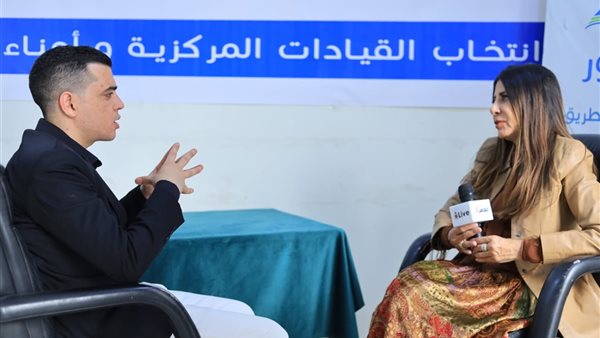
Dr. Wafa Sabry in her interview with Cairo 24:
The elections that I won were held in accordance with the approved institutional framework, and we are addressing the Party Affairs Committee to officially confirm them
Parallel elections are the result of internal disputes… and the dispute must be managed from within institutions, not through separate paths
I will not take a unilateral decision regarding the return of the expelled. Any step will be decided by the General Assembly and in accordance with the regulations
Our goal is to rebuild the organization, adjust the regulations, and clearly define the competencies
The opposition exists and operates in the available spaces. We are not a nihilistic opposition, but rather we offer realistic alternatives
Our absence from Parliament is due to a lack of organizational preparedness. We are currently focusing on preparing cadres for the local elections
In the wake of the revolution of January 25, 2011, the Constitution Party emerged from the womb of this revolution. Much was relied upon, as a number of political and academic figures were associated with it since its inception, including Dr. Mohamed ElBaradei and Dr. Nabil Fahmy, not to mention Dr. Hala Shukrallah. In addition, it included in its membership public figures, former representatives, academics, and youth from various trends, and in its first general assembly in 2012, it reached nearly 22,000 members.
However, after years of founding, the party faced internal challenges represented in organizational disputes, conflicts over the management of the stage, and divisions that reached the point of holding parallel elections recently, as well as a noticeable decline in the volume of participation within the General Assembly compared to the beginning. These challenges put the new leadership before a difficult test: Can the party restore its cohesion and its role in the political scene?
In this context, Cairo 24 conducted a lengthy dialogue with Dr. Wafaa Sabryhead of the Constitution Party, after her election, to talk about the reasons for the decline in party membership, the parallel elections crisis, the file of those dismissed, the reconstruction plan, the party’s position within the opposition and the civil movement, and her vision for the party’s future. And the text of the dialogue:
In the beginning… the Constitution Party was one of the parties that was founded after the January Revolution, and its membership reached about 22 thousand members in the first general assembly in 2012, while today the number has declined significantly… What is the reason for this?
Indeed, the Constitution Party was launched with a wide presence and a large membership base, as the first general assembly included approximately 22 thousand members. The party emerged from the womb of the January 25 revolution, and was an expression of the dream of change that Egyptians rallied around, the dream of living, freedom, and human dignity.
At that time, multiple groups from different intellectual and political spectrums, and from diverse ages and backgrounds joined it, which constituted a real source of wealth for the party, but at the same time it created a state of organizational fluidity, given that growth was extremely rapid, in parallel with a political scene that was changing at a successive pace.
Although there was an organizational list, a political program, and secretariats already in place, the party at that stage was unable to adequately rearrange its internal structure. We were moving under the pressure and acceleration of events, in light of a state of general political fluidity that the country witnessed, and with the successive developments, differences emerged in reactions and viewpoints among members on how to deal with each political station. As a result, the party did not have an appropriate opportunity to consolidate the internal organizational structure, and with the absence of sufficient institutional discipline, disputes and conflicts began to appear, something that was naturally reflected in the cohesion of the party and the participation rates of its members.

I would like to emphasize an important point, which is that the General Assembly today is not numbered in dozens as is rumored, but rather includes several hundred members. It is true that the number is much smaller compared to the beginning, but it remains a significant number.
The difference is that some of the members, due to frustration, became less interactive or stayed away from participation. Our goal at the current stage is to restore this confidence and work to reintegrate these members into party activities and events in an effective and organized manner.
A few days ago, Counselor Ibrahim Al-Azab was announced as the party’s leader in another election. How do you explain this matter?
I am the head of the Constitution Party, according to the official elections held within the party, which were held in accordance with the approved institutional framework, in the presence of public and political figures, and through communication with the Party Affairs Committee through the party’s legal secretariat. As for the parallel elections that took place, they came as a result of disagreements that arose between some colleagues and the previous administration, as they decided, unfortunately, to take a separate path and organize another electoral process.
I have the utmost respect for them, and I have worked with some of them for extended periods, but I reject the principle of any different group within a political entity turning to a parallel track or a separate entity. This approach weakens the party and sends a negative message to public opinion that the internal crisis continues.
Disagreements should be managed and addressed from within institutions, and according to the organizing regulations, not by creating a parallel organizational reality. The party has a clear institutional framework, and any path outside this framework cannot be considered an expression of organizational legitimacy.
I am also currently addressing the Party Affairs Committee in order to confirm the party’s general assembly and announce my victory as head of the Constitution Party.
How did you follow the handling of Professor Jamila Ismail, former head of the party, with the crisis of dismissal of members of the Supreme Council and the resulting division?
The crisis came as a result of extended accumulations and differences in visions regarding party management at a very sensitive stage, and it is natural for dismissal or exclusion decisions within any political entity to raise a state of tension and tension.

I am not inclined to prosecute a previous administration, but what is certain is that we emerged from the experience with important lessons, foremost of which is the necessity of having clear and specific mechanisms for managing disagreement, with full activation of the party’s institutions, so that any political or organizational disagreement does not turn into a division that affects the unity of the entity.
Can you provide guarantees for the reunification initiative and the return of some expelled members?
The Constitution Party is, by its nature, an institutional party, and decisions within it are not taken individually. Any step related to this file will be taken in accordance with the provisions of the bylaws, and by a decision issued by the General Assembly.
I will not make a unilateral decision in this matter, but I believe that any member who has a real desire to work within the institutional framework is welcome, provided that he adheres to the regulating rules. Reform should take place from within, and in a way that preserves the cohesion of the entity and does not expose it to further weakness.
Amidst these crises and divisions…why did you accept to run in the party leadership elections?
I accepted the candidacy out of true affiliation to the party, and I am proud of my affiliation to the Constitution Party, which was linked to the dream of change on January 25, and to the principles of life, freedom, and human dignity, which are principles that still represent legitimate demands for Egyptians.

I felt that this stage imposes responsibility, and that withdrawal is not an option at a moment that needs rebuilding. We are facing an entitlement that requires focusing internally, on controlling the regulations, restructuring the organization, and clearly defining the competencies.
Our goal is to work according to a modern, disciplined and transparent management approach, so that each secretariat has specific objectives, and performance is evaluated based on the extent to which these objectives are achieved.
Is there real opposition in Egypt now, or has the role become symbolic?
The opposition exists, but its scope varies. Politics is the art of achieving what is possible in light of the available data. We invest in all available spaces, from seminars and events to social media platforms, and present alternative policy papers that express our vision.
Opposition, in our view, is not a nihilistic position based on rejection, but rather a responsible practice based on presenting alternatives. We support what we see as right, and oppose what we see as needing review, while offering realistic, workable solutions.
What is your assessment of the performance of the civil democratic movement? Is the Constitution Party still an active part in it?
We are part of the civil movement, and we participate in its various meetings and activities. The movement represents an important coordination space between civil parties, despite the differences in viewpoints that may exist.
We are keen to present our vision in economic and social issues, and to participate in conferences and workshops that discuss current challenges, in a way that contributes to the development of common positions as much as possible.
Why was the party absent from the current parliament? How do you plan for the future?
The absence was linked to internal organizational factors, and the absence of complete readiness at the electoral moment. It is not possible to contest any electoral entitlement effectively without the presence of a strong and cohesive party machine. We are currently focusing on preparing real cadres, especially with the possibility of holding local elections. Local councils represent a fundamental pillar of political and service work, and restore balance to the parliamentary role, so that the parliamentarian does not turn into a services representative at the expense of his legislative and oversight role.

After everything the party has gone through, why should any young man today join the Constitution Party?
Because the party provides a real space for serious and organized political work. Whoever joins will receive training, participate in actual engagement with societal issues, and contribute to the formulation of alternative policies.
We do not promise anyone positions or positions, but rather the opportunity for real work within an institutional framework. Whoever believes in the idea of organized reform, and wants to be part of a political structure based on commitment and action, the field is open, and action is the governing standard.