

Thursday 12/March/2026 – 10:16 AM
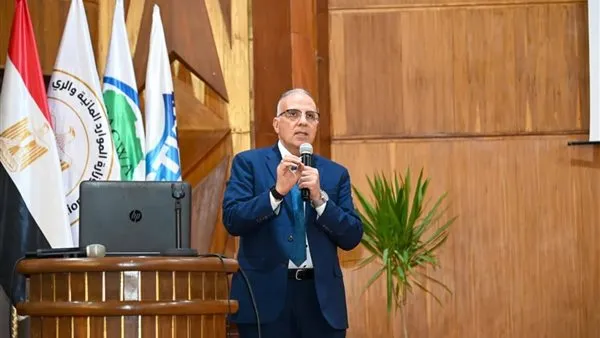
Dr. Hani Sweilem, Minister of Water Resources and Irrigation, witnessed the activities of a symposium evaluating the outcomes of the training process and its effects, which was held at the headquarters of the Regional Training Center for Water Resources and Irrigation in 6th of October, to review the vision and efforts to develop the training system in the ministry, in the presence of Dr. Hussein Al-Atfi, former Minister of Water Resources and Irrigation, Secretary-General of the Arab Water Council, and a number of the ministry’s leaders.
The Minister of Irrigation stresses the importance of training engineers in the ministry on modern technologies
The symposium began with Professor Dr. Salwa Abu Al-Ela, Head of the Regional Training Center for Water Resources and Irrigation, welcoming Dr. Al-Wazir and the attendees, and she gave a presentation on “Evaluating the Outcomes of the Training Process and Their Impacts.”
In his speech at the symposium, Dr. Sweilem pointed out that the comprehensive development work for the water system currently being implemented under the umbrella of the “Second Generation Water System 2.0” is one of the most important goals of the current phase, and that the axes of the second generation are considered an implementation plan for implementing the Ministry’s goals, especially in light of the shortage of engineers and technicians in the Ministry, which is a challenge that can be dealt with by increasing reliance on modern technology, mathematical models, satellite images, and aerial photography with drones, enabling the Ministry to improve the management and distribution process. Water and dealing with the challenge of human resources shortage.
The Minister added that dealing with modern technology requires training the Ministry’s engineers and technicians on various modern technologies in areas such as water treatment and desalination, smart management, digitization, the use of artificial intelligence, digital applications, mathematical models, and satellite image analysis. He pointed out that the Ministry has come a long way in this regard by selecting a number of qualified young engineers in the Ministry and training them on the aspects of the second generation of the water system, preparing them to become future leaders who possess modern science and technology tools used in managing the Ministry’s work system.
Dr. Sweilem praised the role of the Regional Training Center for Water Resources and Irrigation in providing distinguished training programs to build the capabilities of workers in the skills required for this stage of the transformation towards the second generation of the water system, and raising the efficiency of workers in the technical, financial, legal, administrative, languages, communication skills, and personal and leadership skills, noting the presence of distinguished competencies among the retired engineers who are keen to transfer their distinguished experiences to the young engineers and technicians in the ministry with all sincerity, out of belief in the role of the ancient irrigation school in transferring expertise from one generation to the next. Generation.
After that, Dr. Sweilem distributed awards to honor the representatives of the Ministry’s entities who presented the best applied projects that were prepared by them based on the training programs in which they previously participated.
During the symposium, a number of (7) presentations were made by representatives of the various ministry agencies to present the applied projects that were prepared by them based on the training programs in which they previously participated. The Irrigation Department gave a presentation on the “Geographic Information Systems Program for Assessing Climate Change and its Impact on Water in the Valley and the Delta,” the High Dam Authority and the Aswan Reservoir gave a presentation on “Intelligent Engineering for the Maintenance of Water Facilities,” the Mechanical and Electricity Department gave a presentation on “A First Model for the Peace Station,” and the Groundwater Sector gave a presentation on “A model for monitoring using satellite images,” and the Drainage Authority gave a presentation on “Inventorying encroachments on waterways using artificial intelligence in the field of geographic information systems,” and a presentation on “Using pivot tables in quantitative and qualitative data analysis and its applications.” The Irrigation Affairs Sector gave a presentation on “Using artificial intelligence in human resources management.” This was followed by speeches from the engineers, representatives of the program package for transferring expertise in water distribution, and representatives of the package of programs for transferring pioneering experiences in water resources and irrigation law. 147 for the year 2021.