

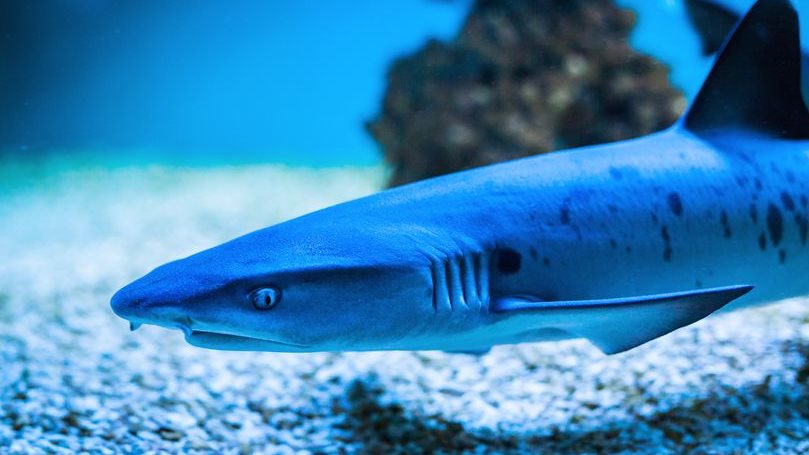
A recent study has found that sharks do not live solitary lives as long thought, but rather form complex social relationships and display distinct preferences in choosing their partners within the groups in which they live.
After years of field monitoring of bull sharks inside the Shark Reef Marine Reserve in Fiji, the study, which was published on March 16 in the journal Animal Behavior, revealed that these marine predators have what resembles stable social networks, meaning that the relationships between them are not random, but rather are based on repeated interaction between specific individuals over time.
From isolated organisms to organized communities
“We humans form a range of social relationships — from casual acquaintances to close friends — and we avoid certain people, and these sharks are doing something similar,” says the study’s lead author, Natasha Marosi, a species conservation expert at the Center for Animal Behavior Research at the University of Exeter in the United Kingdom and founder of the Fiji Shark Laboratory.
This analogy, according to Marosi in statements to Al Jazeera Net, shows that sharks do not meet by chance, but rather choose their partners in a way that reflects real social preferences.
The researcher points out that by analyzing thousands of hours of observation of shark behavior, the team found that these animals tend to stay near specific individuals repeatedly, rather than moving randomly within groups.
This means that relationships between sharks are not transient, but rather recur over time, suggesting a pattern of social organization within these groups.
Researchers liken this pattern to what happens in humans, where there are different circles of relationships, from constant partners with whom you interact frequently, to less frequent relationships.
How are these relationships formed?
The study focused on a fixed feeding site, where sharks are drawn to the same location on a regular basis; This repetition in the presence of the same individuals creates a recurring opportunity for interaction between them, which is an important factor in forming relationships.
The results showed that repeated meetings between the same individuals lead to the formation of a type of familiarity, that is, getting used to the presence of others, which enhances the continuation of these relationships over time. Thus, the gatherings transform from being merely transient gatherings into something resembling organized societies with a clear internal structure.
One of the most prominent results of the study was that adult sharks represent what can be described as the “heart of the social network” within the group, meaning that they are the most interactive and associated with a greater number of individuals than others. They participate in a greater number of interactions, and play an important role in linking the rest of the group together.
In contrast, younger or older sharks tend to stay on the periphery of this network, that is, they are less integrated and have fewer relationships.
According to the lead author, this suggests some kind of informal social arrangement, where some individuals have a more influential role within the group.
Differences between males and females
The study also revealed clear differences in social behavior between males and females. Females tend to form relationships with other females, while males show a greater preference for interacting with females, and often occupy more central positions within the social network.
Marosi adds that although females make up the largest proportion of the group, males on average have a greater number of relationships, indicating a difference in behavioral roles between the sexes within the group.
The results also showed that age is an important factor in shaping social relationships. Adult sharks tend to interact with individuals of the same age, while juvenile sharks have difficulty integrating into central networks.
However, the researchers note that some of the bolder young sharks are able to interact with older individuals, reflecting individual differences in behavior within a species.
The exact reasons behind this behavior are still under study, but researchers suggest several possible explanations, including that social relationships may help sharks improve access to food, reduce risks by being in groups, or increase mating opportunities.
These relationships may also allow the exchange of indirect information about the surrounding environment, which gives sharks an advantage that helps them adapt to complex marine environments.