

Friday 03/April/2026 – 05:00 PM
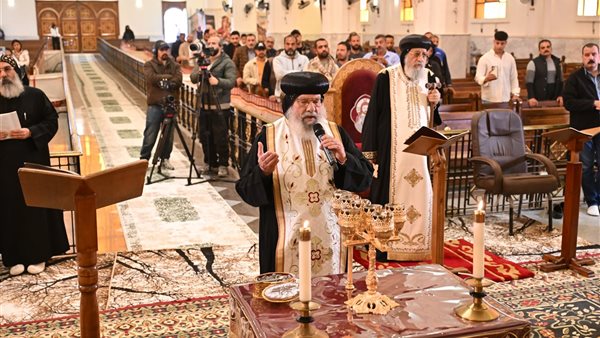
This morning, His Holiness Pope Tawadros II prayed the prayers of the Friday Mass at the end of Lent in the Great Cathedral of the Monastery of Saint Anba Bishoy in Wadi El-Natroun, with the participation of His Eminence Anba Agapius, Bishop and President of the Monastery, and the assembly of his monks, along with members of the church who are visitors to the monastery.
The Friday prayers at the end of fasting, according to the applicable Coptic ritual, included the Qandil prayer (the sacrament of anointing the sick).
In the sermon of the Mass, His Holiness the Pope indicated that today we conclude the fast that began 47 days ago, which is the fast of the holy forty days, in addition to the week of preparation.
He explained that the church on this day holds a ritual that is repeated once a year, although it can be practiced at any time of the year. It is the ritual of the sacrament of anointing the sick, “the general lamp,” because in it we light seven lamp candles for the seven prayers.
Pope Tawadros prays the Friday Mass at the end of Lent in the Grand Cathedral
He added: “The Church practices this sacrament for the illnesses of our souls, bodies, and spirits so that God may heal them. In it, we are anointed with holy oil so that the Church teaches us to enter Holy Week healthy, pure, and loved after the period of Great Lent (the period of repentance), so we enter it and live it with all our feelings.”
Regarding Holy Week, His Holiness said: “It is events from the past that we live in the present. They are the events of Christ’s salvation that took place on the cross, then his death and resurrection. These events were in the past, but they always live because they are for the sake of man’s redemption and salvation. We live them in the present at the level of melodies, readings, and ritual practices (protests and fasts).”
He continued the explanation: “In the Sacrament of the Anointing of the Sick, we pray for the sick, the catechumens, the travelers, the officials, the departed, and those who offer sacrifices, as the entire Church is members of the Body of Christ, so everyone becomes in spiritual health and deserves to advance to the Holy Week of Passion, which we call (the Life-giving Passion). Anointing with oil is done on the forehead, throat, and hands to sanctify a person’s thoughts, words, and deeds, and that is the ecclesiastical importance of the Friday at the conclusion of Lent.”
Pope Tawadros
Continue: Regarding the historical importance of the conclusion of Lent, His Holiness the Pope noted that it is due to the situation that happened with the Lord Christ in the Galilee region north of Jerusalem, where the Pharisees spoke to him to flee from Herod. As for the Lord Christ, he said, “Go and tell this fox: Behold, I cast out devils and heal them.” Today and tomorrow, and on the third day I will complete it.” (Luke 13:32) to confirm that his life and all his steps had a plan. After that, Christ spoke about Jerusalem (the city of peace) that had not experienced this peace at all, as the history of the city of Jerusalem goes back 3000 years, full of wars9, conflicts, and blood, and it is said that it did not enjoy peace for only 30 years. Christ called her with warning and anger, “O Jerusalem, Jerusalem, you who kill the prophets and stone those who are sent to you! How often have I wanted to gather your children together as you gather “The hen has her chicks under her wings, and you would not; behold, your house is left to you desolate.” (Luke 13:34-35)
The Pope continued: This call is for every soul that has turned away from Christ. He called on it more than once to turn away from sin, but it did not want to. How many times did Christ want good for humans? He wanted them to correct themselves, to free them from sins, to end strife, and to correct the divisions in the service, but they did not want to. Let us learn to pray that our will is in agreement with God’s will every time we say, “Thy will be done.”
He said: God wants to bring together man’s thoughts and feelings, to bring together the divided house and the divided service, and we do not want it, so the end will be difficult, which came from Christ honestly and with an important and unfortunate message, continuing: This is what happened in the history of the city of Jerusalem, in the year 70 AD. The Roman Emperor, through his leader Titus, attacked Jerusalem, destroyed the temple, slaughtered pigs in its halls, and trampled on the prayer books. This house was finished and became a ruin to this day.
He added: The most important question is: What is the problem in Jerusalem? It is the problem of every soul who rejects the call of Christ, which is “stubbornness.” There are those who are stubborn against themselves, their family, their friends, their community, their church, and even God himself. He continued: It is good for us to pray today that the punishment of Jerusalem will not fall upon us and that God will save us from the sin of stubbornness and give us a heart that understands, lives, and knows what is good for him. We pray that God will keep away from us the hardness of the heart so that we will not become a “house of ruin.” Stubbornness is a sin from birth that makes a person unsuccessful in his society. Before him are the doors of many other sins and failures.
Pope Tawadros
Continue: Christ says to all of us today, “How many times have you wanted and not wanted?” So be careful not to be the cause of division in your home, your service, your life, and your work. This blessed day is dedicated to us all repenting from the sin of stubbornness, and the Church, as a merciful mother, does not want us to enter Holy Week living in this sin. Pay attention to the opportunities and blessings that God gives you, in a book, in a sermon, or in any message that comes to you from God, and make your prayer that God remove from within you all stubbornness in any form so that you do not hear this harsh judgment: “Behold, your house is left to you desolate.”
Conclusion: We are preparing for the events of the Holy Week, which ends with the glorious Feast of Resurrection. Be prepared to enter these holy days with purity and a heart far from weaknesses, so that you will be able to respond to all of God’s messages that He presents to you.