
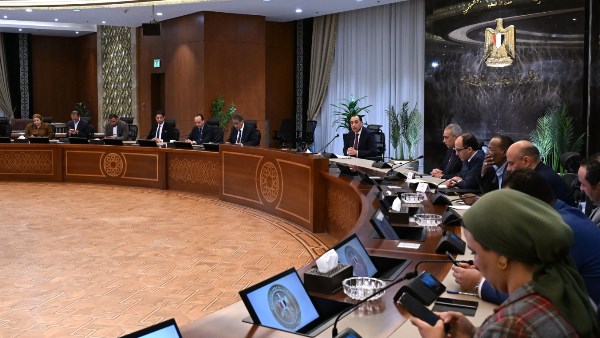
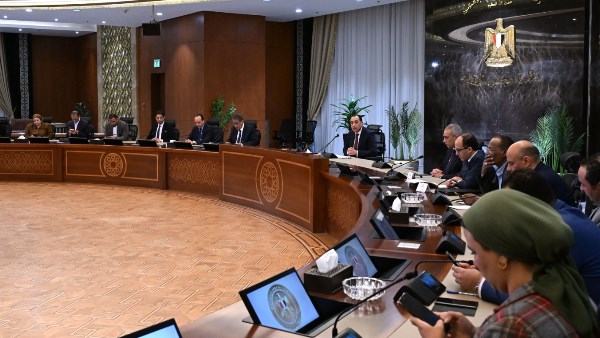
Dr. Mostafa Madbouly, Prime Minister, held this evening the weekly press conference at the government headquarters in the new capital, in the presence of Diaa Rashwan, Minister of State for Information.
The Prime Minister began the conference by welcoming the attendees to this meeting, which was held coinciding with the last days of the holy month of Ramadan, saying: “Allow me to take this opportunity to extend my sincere congratulations to His Excellency President Abdel Fattah El-Sisi, President of the Republic, and to the masses of the great Egyptian people, and the peoples of the Arab and Islamic nations, on the occasion of the approaching advent of the blessed Eid Al-Fitr, asking God Almighty to always bring it back to us with goodness, right and blessings.”
The Prime Minister indicated that this Eid falls under very delicate circumstances that the region is going through, pointing out that global attention is currently focused on the ongoing war in the region. The “American, Israeli, Iranian war” and its broad repercussions that are felt by the entire world, starting with the countries of the region that are directly affected, all the way to all the countries of the world, especially in light of the grave economic challenges imposed by this severe crisis, which has drawn the attention and warnings of most global economic institutions.
He added: Here I would like to reaffirm the constants of the Egyptian position regarding this war. In order for things to be clear to everyone; The Egyptian state affirmed from the beginning its categorical rejection of this war, based on a clear vision and complete belief in its dangerous repercussions that will cast a shadow over the region and the entire world, which we are witnessing as a tangible reality today.
He continued: We affirm our complete condemnation of the attacks targeting our sister Arab countries, whether in the Arabian Gulf region, or Jordan and Iraq. Here I stress categorically that the Egyptian position – which His Excellency the President of the Republic expressed very clearly in all forums and in his contacts with his fellow leaders of these countries and international leaders – is based on a complete rejection of the war and a strong condemnation of all forms of aggression against the sisterly Arab countries.
The Prime Minister went on to say: We were keen to try in every possible way to find a basis for stopping military operations and giving the opportunity to negotiate. Because the conflict will not end or be resolved with a military solution on the ground, but rather there must be a political solution to stop this battle. Therefore, we affirm once again that the official position of the Egyptian state – its leadership, government, and the Egyptian people of all sects – is that we stand by our brothers from the Arab countries that are currently being subjected to attacks, and we affirm our full solidarity with them, and Egypt’s readiness – of course always – to provide them with all means of support.
In the context of reviewing the economic repercussions, Dr. Mostafa Madbouly said: Based on your follow-up of the repercussions of this war on the entire world, it can be said with the utmost transparency to citizens that since the outbreak of this crisis we have begun to fully realize the extent of the direct and indirect impact on the Egyptian economy. Therefore, the Central Crisis Committee was immediately formed, which meets once or twice a week, the last of which was yesterday’s meeting, which lasted more than three hours. To discuss the repercussions of war and military operations. But there is still a clear challenge before us and the whole world, which is the inability to conclude a specific time frame for the end of this war. There are many interpretations and expectations that it will extend for weeks, and other sayings expect it to extend for months to come, and whether it extends for weeks or months, all of this has major impacts on the world’s economies.
He added: The media must present these repercussions and the world’s suffering from them, including inflation and a rise in the prices of fuel and various goods and products, which has also affected major countries. Hence, everyone must be aware that we are facing a real global crisis, an exceptional crisis that has made the world reel in extremely difficult circumstances, and there are reports issued by international institutions warning of the repercussions of this war that will affect everyone, and will leave its effects even after it stops.
He said: As a country, we have read this scene from the first moment, and we are studying the decisions and measures that can be taken to reduce the effects of these repercussions on the state and the citizen, and we are keen to inform the citizen of all the steps and procedures that the government is taking. Perhaps this is what His Excellency the President of the Republic stressed at the Egyptian family iftar party, regarding the necessity of the Egyptian citizen’s participation in all the details of the crisis and the measures that the government is taking regarding it.
The Prime Minister continued: In this regard, I will present some numbers to determine the dimensions of the current situation. The basis of the movement of any economy is energy, represented by petroleum products, natural gas and electricity, which depend for the largest part of their production and generation on natural gas, according to what was stated in the explanation of His Excellency the President of the Republic. The day before the outbreak of war, the monthly bill for natural gas that Egypt imports from abroad to meet its needs – in addition to local production – was $560 million per month. Today, how much does the same amount cost? It has reached one billion and 650 million dollars; Here it is necessary to point out the difference between the numbers 560 million and 1 billion and 650 million, that is, an increase of 1 billion and 100 million dollars per month. This is to provide the gas necessary to generate electricity and pump it into the network to ensure the operation of factories and production and provide job opportunities.
He added: This is with regard to the gas item alone, but with regard to petroleum products and their developments; The day before the outbreak of war, the price of a barrel of oil was $69, and when decisions were taken that were well known that they might be met with dissatisfaction due to the increase in prices, the price of a barrel at that time had reached $93, then it dropped a day or two later to $87. Some opinions even suggested at the time that the decision had been made hastily and should have been waited.
The Prime Minister indicated that before this meeting, the price reached $108.5, an increase of $15 from the day the decisions were announced. This increase came as a result of frequent news about targeting some oil facilities in Iran, which led to severe confusion in the market. One piece of news affects the price, and the state is obligated to meet the country’s needs, and here lies the issue I am addressing now.
Dr. Mostafa Madbouly pointed out that the price, which settled at $69 before the war, yesterday ranged between $103 and $105, now reaching $108.5, indicating that there are analyzes that suggest that if the situation worsens, we may reach $150 and $200 per barrel. He explained that this simply means that even if the price stopped at the level of $105 – regardless of the increase occurring now – crude oil would have increased by 50%.
The Prime Minister said: The most important thing is (diesel), which is included in everything; The value of a ton of diesel before the war was $665, and today its price has jumped to $1,604, meaning the increase is close to $1,000 per ton. Likewise, (butane gas) went in the same way. Its price was $510 per ton, and today it has reached $720 and $730, an increase of up to 33% or 34%.
The Prime Minister explained that the state is committed to providing a monthly bill for energy needs, but this bill has now doubled to two or two and a half times. However, the state is required to ensure the movement of the economy and deal with this crisis, indicating that the clear challenge before the government is the time frame for this war. If it continues for a month or two, the state will try as much as possible to bear its repercussions, but current estimates indicate the possibility that it will continue for several months, or until the end of the year 2026, which imposes a large burden on the state to meet the needs necessary to keep the country moving.
He added: We have taken decisions to increase prices and we are fully aware of the repercussions of that on the prices of fuel, goods and products, but those decisions were based on the price of $93 per barrel, but today, in light of the current increases, it is not possible to continue to confront the matter with price increases alone, but there must be other ideas, most important of which is rationalization of consumption as a parallel alternative. So rationalization begins in the quantities that are used.
Dr. Mostafa Madbouly pointed out the role of the citizen in integrating with the government in this regard, explaining that rationalization includes the movement of vehicles on the streets, transportation, and electricity consumption. The more we succeed in rationalizing consumption, the more this will contribute to reducing the burden of the monthly bill that the state is obligated to bear.
The Prime Minister expressed his hope that this war would end as soon as possible so that its repercussions would subside and the wheel of life would return to normal, adding: But we are forced to work on the worst scenario, which is an extension of the war. Therefore, the largest part of today’s Cabinet meeting focused on discussing the plan of action for the coming period to deal with these repercussions, primarily the issue of rationalizing consumption.
Dr. Mostafa Madbouly confirmed that the state, for its part, has begun decisions to rationalize spending. With the aim of slowing down some activities and expenditures that were considered normal under normal circumstances, in order to create a large reserve in the budget that is allocated for exceptional measures. Today, the Council decided to suspend or postpone some items for a period of two months to follow up on developments in the situation, and to collect these funds to move in the event that any sudden or exceptional decision is taken.
He pointed out that a decision was issued – the implementation of which was confirmed today – to stop lighting all advertisements on the roads, and to reduce street lighting to the lowest possible percentage without prejudice to security and safety requirements, while directing the ministers, governors, and all concerned parties to strictly implement these measures.
In a context related to the measures taken, the Prime Minister indicated that it was decided to close the entire government district immediately after the Eid holiday at six o’clock in the evening. Where work ends, all employees leave, and the lighting and power network is closed to contribute to the savings process, provided that the employees working in the ministries complete any remaining administrative work from home.
He added: As part of the rationalization measures that have been agreed upon, as of Saturday, March 28, all shops, commercial malls, restaurants and cafes will be closed at nine o’clock in the evening during weekdays, with work allowed until ten o’clock in the evening on Thursdays and Fridays. This measure, according to data from the Ministry of Electricity, will contribute to reducing large consumptions. We realize that the affected establishments may see this as harm to their business, but we are taking gradual measures. This decision will be implemented for one month, starting from March 28, and will be reviewed. If the crisis ends, we will withdraw from these decisions, but if it continues, we will be forced to extend it.
Dr. Mustafa Madbouly continued: With the growing challenges, we are currently studying in the Crisis Committee and the Council of Ministers the application of the remote work system (online) for one or two days a week, to include all government agencies and the private sector, with an emphasis on excluding factories, production units, infrastructure units (water, electricity, gas), the transportation sector, and health facilities, while its application to any other possible sectors will be studied as a possible measure if the crisis continues.
The Prime Minister explained that the state is following a gradual approach to avoid a shock in the economy, stressing that the primary goal is to reduce the consumption bill. Because the alternative would be to resort to further raising prices, which the government sees as very harmful to the economy because it leads to inflationary waves, at a time when inflation has begun to take a downward path, saying: We are doing our best to preserve the gains that have been achieved, and take into account the citizens’ ability to endure and deal with this crisis.
He went on to say: The government never aims to pressure the citizen, but I explain with the utmost transparency and in numbers the size of the bill that the state bears. When the bill doubles by two or two and a half times, and may even triple, the available resources cannot bear that except by reducing other expenses, which is something we do not hope to reach, and, God willing, we will not reach.
The Prime Minister continued: All the scenarios presented are what prompted the government to take these measures. There were opinions calling for implementing all the steps at once, but we chose to follow the gradual methodology, starting with the group that was announced, while continuing to study the situation during the coming days, and we may resort to implementing the remote work system (online) for one or two days a week.
Dr. Mostafa Madbouly confirmed that the Crisis Committee is following developments around the clock, referring to the important meeting held this week with the Federation of Industries and the Federation of Chambers of Commerce, where everyone praised the government’s approach to dealing with the crisis, stressing that the state’s top priority is to ensure the continuation of the industry, production and employment system. To ensure the abundance of goods and products, which automatically leads to a price balance as a result of competition and increased supply.
He added: If we remember the scarcity of goods in the years 2023 and 2024, today, thank God, we have a very large stock. The Chambers of Industry confirmed that there is a stock of raw materials for some goods sufficient for a whole year, so there is no problem with the abundance of manufacturing, and our goal is to keep the wheel of production turning, which is why we excluded factories and production projects from the remote work system.
With regard to rationalizing the consumption of petroleum products, the Prime Minister explained that it was agreed to postpone some projects that are intensive in consumption of “diesel”, in particular, on an exceptional basis, provided that the situation will be evaluated monthly. These projects will be slowed down for a month, with the possibility of extending them if the crisis continues.
The Prime Minister concluded the press conference by emphasizing that these measures come within the framework of confronting a global crisis that the whole world is suffering from, saying: Energy prices are witnessing unprecedented booms internationally, and we as a government are doing our utmost to deal with this severe crisis, and to ensure that economic indicators are stable and not shaken. Despite what international institutions indicate about the economic repercussions that may affect Egypt and other countries, there is international praise for the proactive measures taken by the Egyptian state.
He stressed that: Despite the burdens these measures may represent, we are forced, in light of these exceptional circumstances, to adopt solutions that guarantee the least possible harm to the citizen, and at the same time ensure the continuation of the state and the wheel of production.