
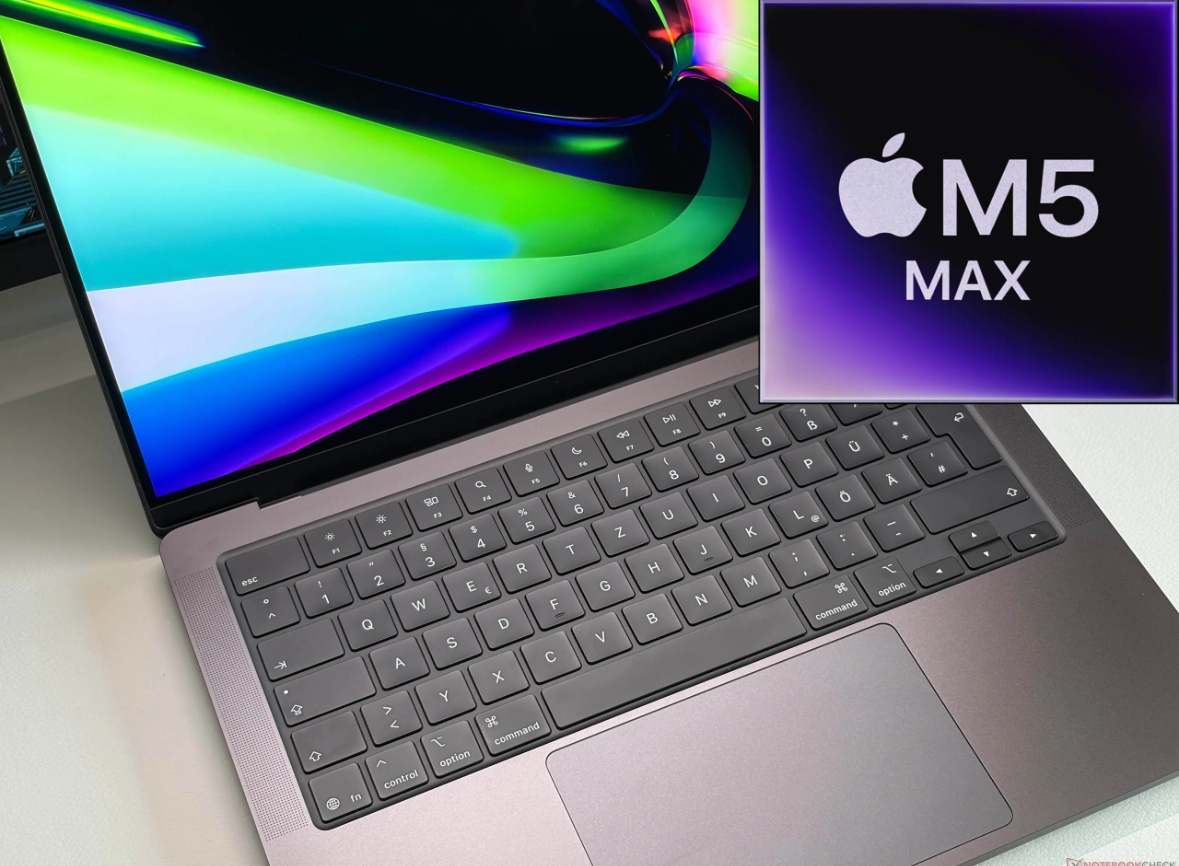
Apple once again introduced its most powerful chipset, the M5 Max with 18 processor cores and 40 graphics cores, for the small MacBook Pro 14, which was recently tested. However, our tests showed some limitations, including the inadequacy of the included power adapter.
During the stress test, the M5 Max chip (with the processor and graphics cores combined but not the RAM) consumed up to 96W for a short period of one to two seconds, then dropped directly to 46W, but it did not continue at this value and finally settled at 42W.
The MacBook Pro 16 here has better performance, as the M5 Pro chip can consume 70 watts during the stress test, that is, 66% more, which clearly reflects the difference in the comparison graph.
When testing processor or graphics consumption separately, this behavior persisted; The CPU processor can reach 75 watts for a short period before dropping to about 50 watts, while the GPU consumption reaches 72 watts and then gradually declines to 55 and 44 watts in High Power mode.

With sustained loads, GPU performance does not remain stable, but drops by about 10%, while the MacBook Pro 16 excels in bringing out the full power of the M5 Max chip with 40 graphics cores, and this will become clear when testing a new unit soon.
The current M5 chip is based on a 3nm (3rd generation) manufacturing process, and the upcoming M6 chipsets are expected to move to 2nm via TSMC, improving efficiency.
However, these chipsets become so powerful that Apple may need to redesign the MacBook hardware and incorporate stronger cooling solutions to maintain optimal performance.